| --- |
| license: bsd-3-clause |
| library_name: braindecode |
| pipeline_tag: feature-extraction |
| tags: |
| - eeg |
| - biosignal |
| - pytorch |
| - neuroscience |
| - braindecode |
| - foundation-model |
| - transformer |
| --- |
| |
| # PBT |
|
|
| Patched Brain Transformer (PBT) model from Klein et al (2025) [pbt]. |
|
|
| > **Architecture-only repository.** Documents the |
| > `braindecode.models.PBT` class. **No pretrained weights are |
| > distributed here.** Instantiate the model and train it on your own |
| > data. |
|
|
| ## Quick start |
|
|
| ```bash |
| pip install braindecode |
| ``` |
|
|
| ```python |
| from braindecode.models import PBT |
| |
| model = PBT( |
| n_chans=22, |
| sfreq=250, |
| input_window_seconds=4.0, |
| n_outputs=4, |
| ) |
| ``` |
|
|
| The signal-shape arguments above are illustrative defaults — adjust to |
| match your recording. |
|
|
| ## Documentation |
| - Full API reference: <https://braindecode.org/stable/generated/braindecode.models.PBT.html> |
| - Interactive browser (live instantiation, parameter counts): |
| <https://huggingface.co/spaces/braindecode/model-explorer> |
| - Source on GitHub: <https://github.com/braindecode/braindecode/blob/master/braindecode/models/patchedtransformer.py#L17> |
|
|
|
|
| ## Architecture |
|
|
| 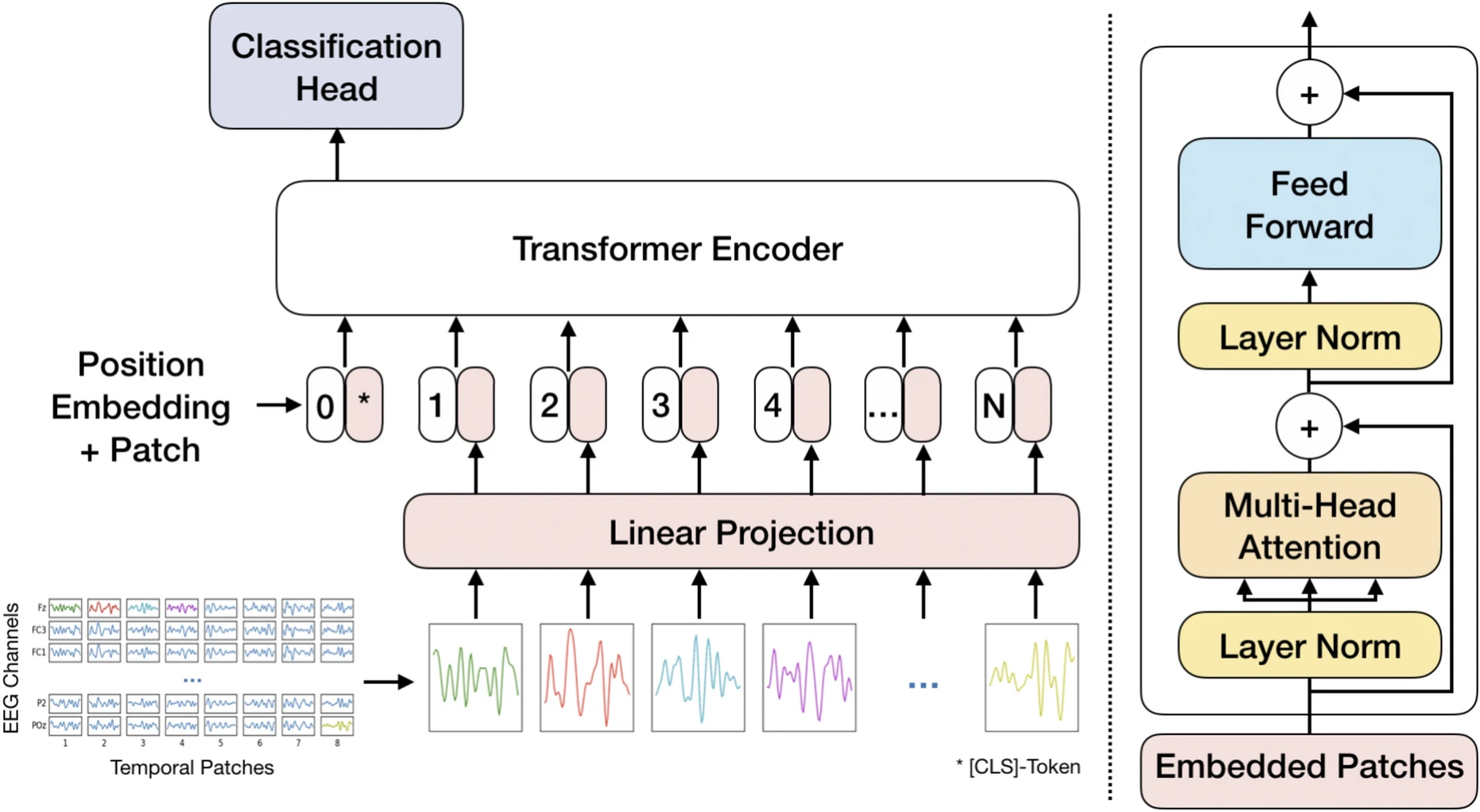 |
|
|
|
|
| ## Parameters |
|
|
| | Parameter | Type | Description | |
| |---|---|---| |
| | `d_input` | int, optional | Size (in samples) of each patch (token) extracted along the time axis. | |
| | `embed_dim` | int, optional | Transformer embedding dimensionality. | |
| | `num_layers` | int, optional | Number of Transformer encoder layers. | |
| | `num_heads` | int, optional | Number of attention heads. | |
| | `drop_prob` | float, optional | Dropout probability used in Transformer components. | |
| | `learnable_cls` | bool, optional | Whether the classification token is learnable. | |
| | `bias_transformer` | bool, optional | Whether to use bias in Transformer linear layers. | |
| | `activation` | nn.Module, optional | Activation function class to use in Transformer feed-forward layers. | |
|
|
|
|
| ## References |
|
|
| 1. Klein, T., Minakowski, P., & Sager, S. (2025). Flexible Patched Brain Transformer model for EEG decoding. Scientific Reports, 15(1), 1-12. https://www.nature.com/articles/s41598-025-86294-3 |
| 2. Dosovitskiy, A., Beyer, L., Kolesnikov, A., Weissenborn, D., Zhai, X., Unterthiner, T., Dehghani, M., Minderer, M., Heigold, G., Gelly, S., Uszkoreit, J. & Houlsby, N. (2021). An Image is Worth 16x16 Words: Transformers for Image Recognition at Scale. International Conference on Learning Representations (ICLR). |
| 3. Krell, M. M., Kosec, M., Perez, S. P., & Fitzgibbon, A. (2021). Efficient sequence packing without cross-contamination: Accelerating large language models without impacting performance. arXiv preprint arXiv:2107.02027. |
|
|
|
|
| ## Citation |
|
|
| Cite the original architecture paper (see *References* above) and braindecode: |
|
|
| ```bibtex |
| @article{aristimunha2025braindecode, |
| title = {Braindecode: a deep learning library for raw electrophysiological data}, |
| author = {Aristimunha, Bruno and others}, |
| journal = {Zenodo}, |
| year = {2025}, |
| doi = {10.5281/zenodo.17699192}, |
| } |
| ``` |
|
|
| ## License |
|
|
| BSD-3-Clause for the model code (matching braindecode). |
| Pretraining-derived weights, if you fine-tune from a checkpoint, |
| inherit the licence of that checkpoint and its training corpus. |
|
|


