


metadata
license: bsd-3-clause
library_name: braindecode
pipeline_tag: feature-extraction
tags:
  - eeg
  - biosignal
  - pytorch
  - neuroscience
  - braindecode
  - foundation-model
  - convolutional
Labram
Labram from Jiang, W B et al (2024) [Jiang2024].
Architecture-only repository. Documents the
braindecode.models.Labramclass. No pretrained weights are distributed here. Instantiate the model and train it on your own data.
Quick start
pip install braindecode
from braindecode.models import Labram

model = Labram(
    n_chans=22,
    sfreq=200,
    input_window_seconds=4.0,
    n_outputs=2,
)
The signal-shape arguments above are illustrative defaults — adjust to match your recording.
Documentation
- Full API reference: https://braindecode.org/stable/generated/braindecode.models.Labram.html
- Interactive browser (live instantiation, parameter counts): https://huggingface.co/spaces/braindecode/model-explorer
- Source on GitHub: https://github.com/braindecode/braindecode/blob/master/braindecode/models/labram.py#L196
Architecture
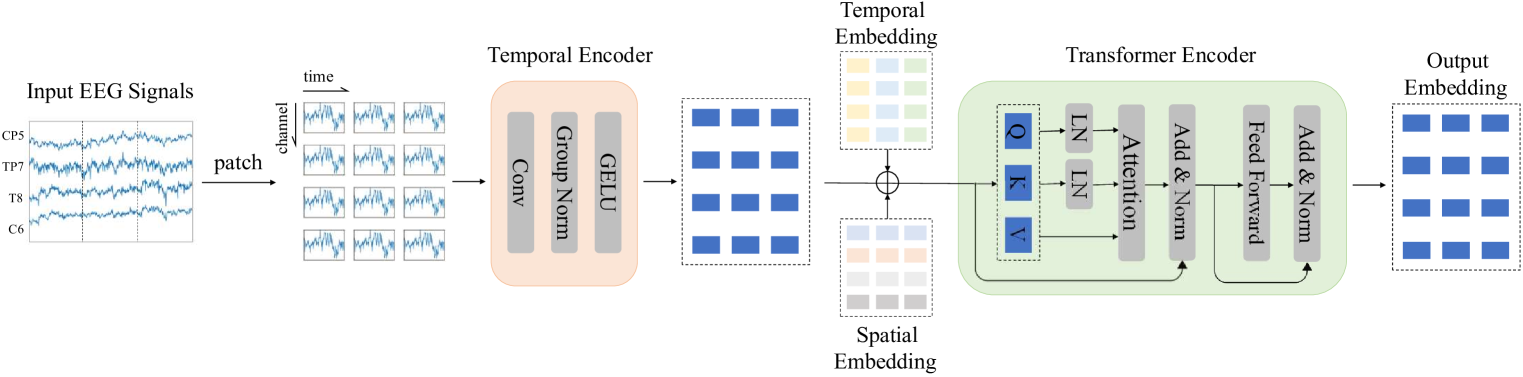
Parameters
| Parameter | Type | Description |
|---|---|---|
patch_size |
int | The size of the patch to be used in the patch embedding. |
learned_patcher |
bool | Whether to use a learned patch embedding (via a convolutional layer) or a fixed patch embedding (via rearrangement). |
embed_dim |
int | The dimension of the embedding. |
conv_in_channels |
int | The number of convolutional input channels. |
conv_out_channels |
int | The number of convolutional output channels. |
num_layers |
int (default=12) | The number of attention layers of the model. |
num_heads |
int (default=10) | The number of attention heads. |
mlp_ratio |
float (default=4.0) | The expansion ratio of the mlp layer |
qkv_bias |
bool (default=False) | If True, add a learnable bias to the query, key, and value tensors. |
qk_norm |
Pytorch Normalize layer (default=nn.LayerNorm) | If not None, apply LayerNorm to the query and key tensors. Default is nn.LayerNorm for better weight transfer from original LaBraM. Set to None to disable Q,K normalization. |
qk_scale |
float (default=None) | If not None, use this value as the scale factor. If None, use head_dim**-0.5, where head_dim = dim // num_heads. |
drop_prob |
float (default=0.0) | Dropout rate for the attention weights. |
attn_drop_prob |
float (default=0.0) | Dropout rate for the attention weights. |
drop_path_prob |
float (default=0.0) | Dropout rate for the attention weights used on DropPath. |
norm_layer |
Pytorch Normalize layer (default=nn.LayerNorm) | The normalization layer to be used. |
init_values |
float (default=0.1) | If not None, use this value to initialize the gamma_1 and gamma_2 parameters for residual scaling. Default is 0.1 for better weight transfer from original LaBraM. Set to None to disable. |
use_abs_pos_emb |
bool (default=True) | If True, use absolute position embedding. |
use_mean_pooling |
bool (default=True) | If True, use mean pooling. |
init_scale |
float (default=0.001) | The initial scale to be used in the parameters of the model. |
neural_tokenizer |
bool (default=True) | The model can be used in two modes: Neural Tokenizer or Neural Decoder. |
attn_head_dim |
bool (default=None) | The head dimension to be used in the attention layer, to be used only during pre-training. |
activation: nn.Module, default=nn.GELU |
— | Activation function class to apply. Should be a PyTorch activation module class like nn.ReLU or nn.ELU. Default is nn.GELU. |
References
- Wei-Bang Jiang, Li-Ming Zhao, Bao-Liang Lu. 2024, May. Large Brain Model for Learning Generic Representations with Tremendous EEG Data in BCI. The Twelfth International Conference on Learning Representations, ICLR.
- Wei-Bang Jiang, Li-Ming Zhao, Bao-Liang Lu. 2024. Labram Large Brain Model for Learning Generic Representations with Tremendous EEG Data in BCI. GitHub https://github.com/935963004/LaBraM (accessed 2024-03-02)
- Zhiliang Peng, Li Dong, Hangbo Bao, Qixiang Ye, Furu Wei. 2024. BEiT v2: Masked Image Modeling with Vector-Quantized Visual Tokenizers. arXiv:2208.06366 [cs.CV]
Citation
Cite the original architecture paper (see References above) and braindecode:
@article{aristimunha2025braindecode,
  title   = {Braindecode: a deep learning library for raw electrophysiological data},
  author  = {Aristimunha, Bruno and others},
  journal = {Zenodo},
  year    = {2025},
  doi     = {10.5281/zenodo.17699192},
}
License
BSD-3-Clause for the model code (matching braindecode). Pretraining-derived weights, if you fine-tune from a checkpoint, inherit the licence of that checkpoint and its training corpus.