| --- |
| license: mit |
| pretty_name: MoJev |
| base_model: Qwen/Qwen3.5-0.8B |
| datasets: |
| - MoLeMo-Lab/mojev-mix |
| library_name: transformers |
| pipeline_tag: text-classification |
| tags: |
| - calibration |
| - structured-output |
| - multiple-choice |
| - preference-learning |
| - multimodal |
| - mojev |
| model-index: |
| - name: MoJev |
| results: |
| - task: |
| type: text-classification |
| name: Typed decision scoring |
| dataset: |
| type: MoLeMo-Lab/mojev-mix |
| name: MoJev-Mix test |
| split: test |
| metrics: |
| - type: accuracy |
| value: 0.9323 |
| name: Accuracy |
| --- |
| |
| <img align="right" src="https://molemo-lab.github.io/mojev/assets/molemo-logo.png" width="76" alt="MoLeMo Lab logo"> |
|
|
| # MoJev |
|
|
| [](https://molemo-lab.github.io/mojev/) |
| [](https://huggingface.co/spaces/di-zhang-fdu/mojev) |
| [](https://github.com/MoLeMo-Lab/mojev/blob/master/paper/mojev-preprint.pdf) |
| [](https://github.com/MoLeMo-Lab/mojev) |
| [](https://huggingface.co/datasets/MoLeMo-Lab/mojev-mix) |
|
|
| **Typed, calibrated decisions in one forward pass.** |
|
|
| Contact: [contact@molemo.org](mailto:contact@molemo.org) |
|
|
| This is the trained checkpoint for the |
| [`mojev`](https://github.com/MoLeMo-Lab/mojev) runtime. It scores |
| request-time candidate values from unstructured state and returns schema-bound |
| probability distributions. |
|
|
| | MoJev family resource | location | |
| |---|---| |
| | Code | [MoLeMo-Lab/mojev](https://github.com/MoLeMo-Lab/mojev) | |
| | Model | **MoLeMo-Lab/mojev** | |
| | Dataset | [MoLeMo-Lab/mojev-mix](https://huggingface.co/datasets/MoLeMo-Lab/mojev-mix) | |
| | Results | [MoJev results](https://github.com/MoLeMo-Lab/mojev#results) | |
| | Preprint | [MoJev (PDF)](https://github.com/MoLeMo-Lab/mojev/blob/master/paper/mojev-preprint.pdf) | |
| | Project page | [MoJev](https://molemo-lab.github.io/mojev/) | |
|
|
| ## Interactive demo |
|
|
| [Try MoJev on Hugging Face Spaces](https://huggingface.co/spaces/di-zhang-fdu/mojev): |
| text, one or multiple images, a question, and custom candidates are scored on |
| server-side ZeroGPU. No model weights are downloaded to the browser. |
|
|
| The optional [`browser/`](browser) text export uses asymmetric INT4 linear weights, |
| INT8 token embeddings, and an FP32 decision head. Export scripts and numerical comparisons are described in |
| the [browser guide](https://github.com/MoLeMo-Lab/mojev/tree/master/browser). |
|
|
| ## Model contract |
|
|
| | input | released configuration | |
| |---|---| |
| | state | text and local image references; 16,384-token training truncation | |
| | question | instruction text | |
| | candidates | request-time strings | |
| | output | logits decoded as `Choice`, `Noul`, or `Score` distributions | |
|
|
| Candidate names are supplied by the caller and encoded directly from their text. |
|
|
| MoJev's Qwen3.5 backbone supports 262,144 tokens natively and up to |
| 1,010,000 tokens with [YaRN scaling](https://github.com/vllm-project/recipes/blob/main/Qwen/Qwen3.5.md). |
| The checkpoint records the 16,384-token training window. The MoJev runtime |
| accepts a larger inference state window through `--context-tokens`; the packed |
| sequence also includes question and candidate tokens. |
|
|
| ## Run with the MoJev server |
|
|
| ```sh |
| git clone https://github.com/MoLeMo-Lab/mojev |
| cd mojev |
| pip install -e '.[transformers]' |
| |
| mojev serve MoLeMo-Lab/mojev --port 8000 |
| ``` |
|
|
| For a longer state within the native context: |
|
|
| ```sh |
| mojev serve MoLeMo-Lab/mojev --port 8000 --context-tokens 65536 |
| ``` |
|
|
| ```python |
| from typesafe_sdk import Choice, TypeSafeClient |
| |
| with TypeSafeClient(api_key="local", base_url="http://127.0.0.1:8000") as client: |
| result = client.system_one( |
| state={"document": "I was charged twice. Please fix this ASAP."}, |
| questions={ |
| "category": Choice( |
| instructions="What is this ticket about?", |
| criteria={"billing": None, "technical": None, "other": None}, |
| ) |
| }, |
| ) |
| |
| print(result.choices["category"].choice) |
| print(result.choices["category"].probabilities) |
| ``` |
|
|
| ## Load with Transformers |
|
|
| ```python |
| from transformers import AutoModel, AutoProcessor |
| |
| model = AutoModel.from_pretrained( |
| "MoLeMo-Lab/mojev", |
| trust_remote_code=True, |
| ).to("cuda").eval() |
| processor = AutoProcessor.from_pretrained( |
| "MoLeMo-Lab/mojev", |
| trust_remote_code=True, |
| ) |
| ``` |
|
|
| The model directory contains the scorer implementation through `auto_map`. |
| Packing, candidate sorting, and schema decoding are provided by the |
| [`mojev`](https://github.com/MoLeMo-Lab/mojev) package. |
|
|
| ## Multimodal input |
|
|
| ```sh |
| pip install -e '.[transformers]' |
| mojev serve MoLeMo-Lab/mojev --port 8000 |
| ``` |
|
|
| Use the image marker followed by an absolute path in the request state: |
|
|
| ```python |
| from pathlib import Path |
| |
| image = Path("examples/cat.jpg").resolve() |
| state = f"Identify the subject. <|vision_start|><|image_pad|><|vision_end|>{image}" |
| ``` |
|
|
| The processor expands the image into visual patch tokens in the state branch. |
| Every question and candidate in the request can attend to those tokens. |
|
|
| | candidate set | grey image P(cat) | cat image P(cat) | |
| |---|---:|---:| |
| | `cat`, `dog` | 0.471 | **0.786** | |
| | `cat`, `dog`, `car`, `other` | 0.264 | **0.528** | |
|
|
| ## Evaluation |
|
|
| On 12,000 evaluation decisions, the released checkpoint reaches **93.23%** |
| accuracy with **0.79%** expected calibration error. |
|
|
| ## Architecture |
|
|
|  |
|
|
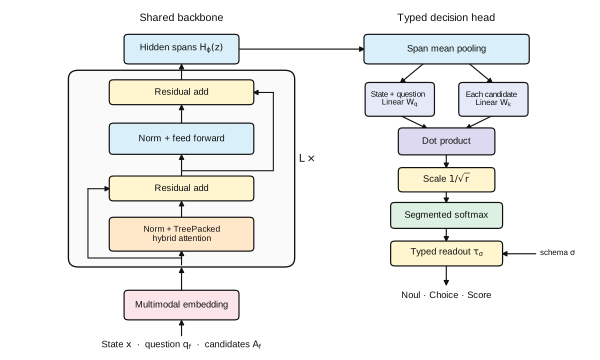
| - Base: Qwen3.5-0.8B; all 854,036,544 parameters trained. |
| - Packing: state, questions, and candidates in one sequence. |
| - Attention: tree mask with isolated question/candidate branches. |
| - Readout: rank-512 context and candidate projections with scaled dot product. |
| - Objective: Plackett–Luce ranking plus Brier calibration loss. |
| - Precision: bf16 encoder and fp32 readout. |
|
|
| ## Training |
|
|
| | item | value | |
| |---|---| |
| | data | 205,084 rows from 18 Open-Jev generators | |
| | epochs | 1 | |
| | parallelism | 8-way data parallel | |
| | learning rate | 1e-5 | |
| | state truncation | 16,384 tokens | |
| | Brier weight | 1.0 | |
| | wall time | 47 minutes | |
|
|
| ## Applications |
|
|
| - routing and triage; |
| - policy and evidence classification; |
| - tool and workflow selection; |
| - calibrated execution, deferral, and escalation thresholds; |
| - multiple typed decisions over shared state. |
|
|
| Code is MIT licensed. The Qwen base model license applies to the checkpoint. |
|
|


