| --- |
| title: AgentDebuggerEnv |
| emoji: 🐞 |
| colorFrom: purple |
| colorTo: indigo |
| sdk: gradio |
| app_file: app.py |
| pinned: false |
| --- |
| |
| # AgentDebuggerEnv |
|
|
| **Hackathon Links:** |
| - 🌌 **[Live Hugging Face Space](https://huggingface.co/spaces/shashaank0707/AgentDebugger-training-v3)** |
| - 📝 **[Read the Technical Writeup](https://huggingface.co/spaces/shashaank0707/AgentDebugger-training-v3/blob/main/Blog.md)** |
|
|
| ### 🚀 One-Line Pitch |
| An OpenEnv-backed reinforcement learning environment that trains LLMs to debug code systematically via Group Relative Policy Optimization (GRPO) and secure sandbox execution. |
|
|
| ### 💡 Why This Exists |
| LLMs often hallucinate bug fixes via blind trial-and-error. Real debugging in production requires hypothesis-driven reasoning, isolation, and verification. We engineered an environment that forces models to observe, hypothesize, and execute code within a secure sandbox—penalizing blind guessing and explicitly rewarding structured problem-solving. |
|
|
| ### 🧠 Key Technical Insights & Research Foundations |
| * **Hypothesis-Driven Debugging (NeurIPS 2025):** Recent research presented at NeurIPS demonstrates that forcing an LLM to formulate a concrete hypothesis before generating code significantly improves debugging accuracy. Inspired by this, our environment mandates a strict `OBSERVATION` → `HYPOTHESIS` → `ACTION` loop. Every single step taken by the agent must be preceded by a formal hypothesis to receive a positive reward. |
| * **Literature-Backed Reward Criteria:** Our continuous, multi-objective reward shaping architecture is heavily influenced by the latest findings in LLM reasoning and code generation capabilities, specifically drawing from: |
| * [arXiv:2408.10215](https://arxiv.org/abs/2408.10215) |
| * [arXiv:2601.19100](https://arxiv.org/abs/2601.19100) |
| * **Curriculum Learning for RL:** A flat bug distribution caused early policy collapse. We implemented a 3-tier curriculum, introducing complex logic bugs only after structural formatting and syntax localization stabilized. |
| * **Hardened Sandboxed Grading:** Evaluating arbitrary LLM-generated fixes introduces severe RCE risks. We engineered a secure execution sandbox that restricts execution time, limits memory, and completely replaces unsafe `exec()` calls, ensuring deterministic and safe grading. |
|
|
| ### 🏗️ Architecture Overview |
| * **OpenEnv Core:** Manages state transitions, agent interactions, and environment telemetry. |
| * **Grader Subsystem:** Multi-layered evaluation utilizing a Hard Grader (secure execution, deterministic AST matching) and a Soft Grader (Llama-3.1-70B semantic evaluation). |
| * **Trainer:** HuggingFace TRL GRPO pipeline with dynamic batch scaling based on runtime VRAM detection. |
| * **Live Monitor:** A Gradio dashboard streaming `stdout` and Weights & Biases metrics directly from the active training container. |
|
|
| ### ⚡ What Makes This Impressive |
| * **Zero-to-One in 250 Steps:** Achieved a ~2.5x increase in total reward within just 250 steps, demonstrating extreme sample efficiency via GRPO. |
| * **Dynamic Hardware Scaling:** The training pipeline natively detects hardware capability (A100/H100 vs. T4) and automatically scales `batch_size`, `grad_accum`, and compute `dtype` (`bfloat16`/`float16`)—eliminating OOM errors across deployment environments. |
| * **Frictionless Deployment:** Bypassed heavy dependency constraints (PyTorch/TRL vs. Gradio PIP conflicts) by engineering a lazy-loading runtime environment that ensures deterministic Docker builds. |
|
|
| ### 🛠️ Tech Stack |
| * **Frameworks:** OpenEnv, FastAPI, Docker |
| * **RL Pipeline:** HuggingFace TRL (GRPO), Peft (LoRA) |
| * **Models:** Qwen2.5-Coder-7B-Instruct (Base), Llama-3.1-70B (Evaluator) |
| * **Telemetry:** Weights & Biases |
|
|
| ### 📊 Results & Benchmarks |
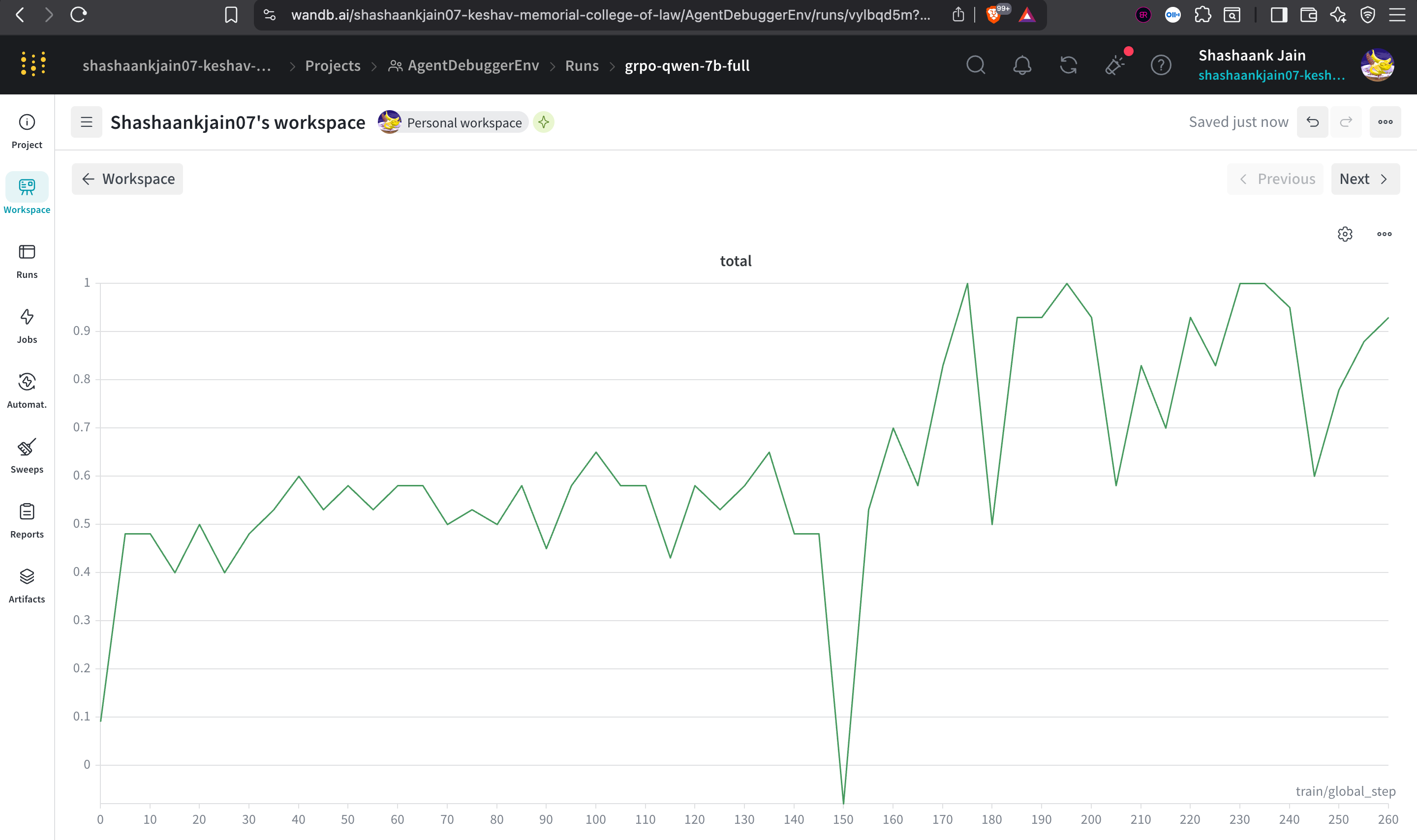
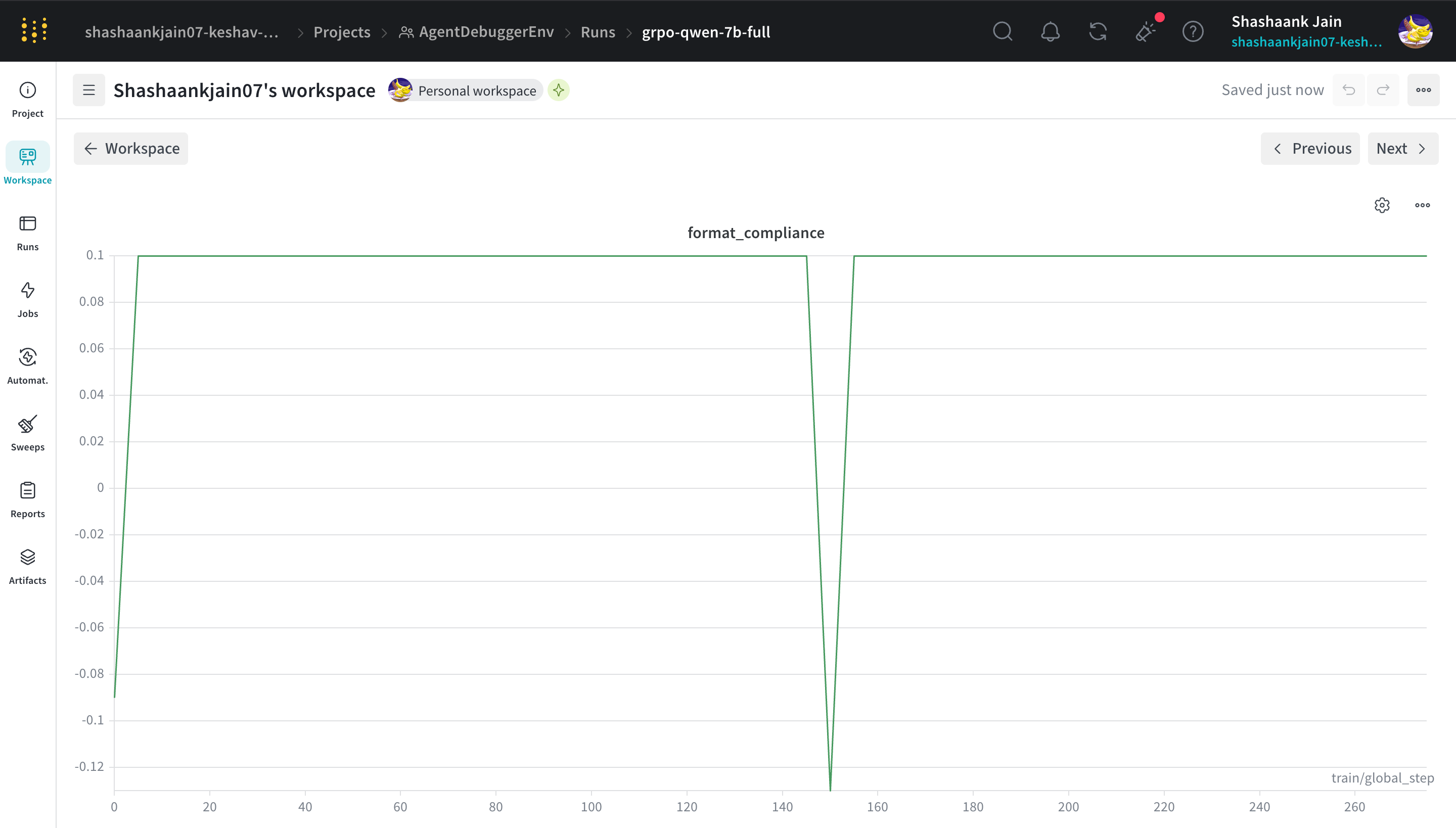
| Our training run clearly demonstrates rapid policy adaptation. The model successfully learned the `OBSERVATION/HYPOTHESIS/ACTION` constraint almost instantly and navigated the tier-2 difficulty bump (step 150) with a textbook drop-and-recover curve. |
|
|
| ## Training Results |
| [W&B Run](https://wandb.ai/shashaankjain07-keshav-memorial-college-of-law/AgentDebuggerEnv/runs/vylbqd5m?nw=nwusershashaankjain07) | [HF Blog](https://huggingface.co/spaces/shashaank0707/AgentDebugger-training-v3/blob/main/Blog.md) |
|
|
| *(Note for Hackathon Judges: Live Weights & Biases charts and Gradio UI are embedded below as evidence of the training run).* |
|
|
|  |
|  |
|
|
| *Additional Training Metrics:* |
| <p align="center"> |
| <img src="https://raw.githubusercontent.com/shasshaank/AgentDebuggerEnv/main/images/hypothesis_quality.png" width="48%" /> |
| <img src="https://raw.githubusercontent.com/shasshaank/AgentDebuggerEnv/main/images/semantic.png" width="48%" /> |
| </p> |
|
|
|  |
|
|
| * **Format Compliance:** Scaled to 1.0 (max) within 50 steps. |
| * **Total Reward:** Scaled from baseline ~0.4 to peaks of ~1.0 by step 250. |
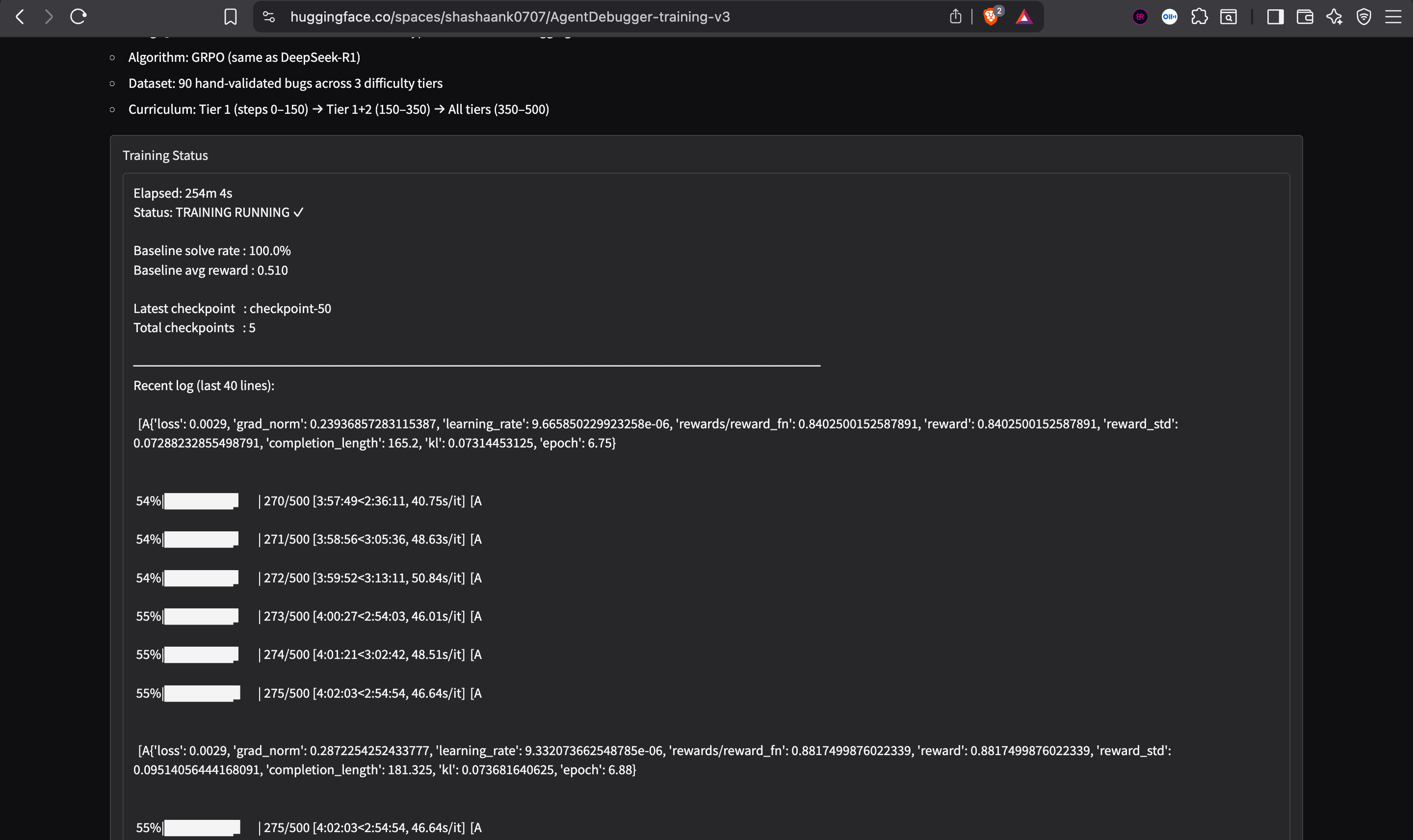
| * **Baseline Solve Rate:** 100.0% validation on tiered data structure. |
|
|
| ### 🔥 Challenges & How They Were Solved |
| * **Reward Hacking:** Initial RL runs showed the model farming points by writing functionally valid code that bypassed the actual bug. **Fix:** Recalibrated the Hard Grader to execute both the initial buggy code and the proposed fix, computing the delta to ensure points are *only* awarded for actual regression fixes. |
| * **Hugging Face Space Build Failures:** The Space suffered from "resolution-too-deep" PIP timeouts due to conflicting requirements between Gradio and `trl/accelerate`. **Fix:** Stripped `requirements.txt` to the bare minimum for the UI and engineered a lazy-load script that installs training dependencies post-boot in a background thread. |
| * **Flaky LLM-as-a-Judge:** Using LLMs to grade code functionality proved non-deterministic. **Fix:** Replaced LLM evaluation for execution success with the deterministic Python sandbox, reserving the LLM judge solely for evaluating the semantic quality of the hypothesis. |
|
|
| ### ▶️ Quick Start |
|
|
| We built the training pipeline to be universally runnable, with a specific focus on reproducible execution for judging. |
|
|
| **Run the Training Notebook** |
| The easiest way to re-run the exact GRPO training pipeline is via our Jupyter Notebook. It auto-detects hardware and sets configurations accordingly. |
| 1. Open `training/AgentDebuggerEnv_GRPO_Training.ipynb` in Google Colab or Kaggle. |
| 2. Select a GPU runtime (T4, A100, etc.). |
| 3. Run all cells. It will automatically install dependencies and start streaming results. |
|
|
|
|
| ### 📂 Code Structure |
| ```text |
| ├── data/ # Tiered bug datasets (JSONL) |
| ├── env/ # OpenEnv environment definitions |
| ├── server/ # FastAPI backend & Grader implementations |
| │ ├── grader_hard.py # Sandboxed deterministic code execution |
| │ └── grader_soft.py # Semantic evaluation logic |
| ├── training/ # GRPO pipeline & Runnable Notebook |
| └── app.py # Gradio training monitor |
| ``` |
|
|
| ### 🤝 If I Had More Time |
| * **Multi-File Contexts:** Expand the environment to handle complex multi-file repository debugging using an active Language Server Protocol (LSP) integration. |
| * **PPO vs GRPO Benchmarking:** Quantify the compute and efficiency tradeoffs between PPO and GRPO on this specific task. |
| * **Adversarial Bug Generation:** Implement an adversarial LLM agent to continuously mutate and generate edge-case bugs, creating an infinite, self-sustaining curriculum. |
|
|
| --- |
|
|
| ### 👥 Team Endurance |
| * **Shashaank Jain** | GitHub: [@shasshaank](https://github.com/shasshaank) | Email: *[shashaankjain07@gmail.com]* |
| * **Pranav Pulipati** | GitHub: [@PulipatiPranav](https://github.com/PulipatiPranav) | Email: *[pranavpulipatix@gmail.com]* |
|
|


