| --- |
| license: apache-2.0 |
| tags: |
| - vision |
| - image-classification |
| datasets: |
| - imagenet-1k |
| widget: |
| - src: https://huggingface.co/datasets/mishig/sample_images/resolve/main/tiger.jpg |
| example_title: Tiger |
| - src: https://huggingface.co/datasets/mishig/sample_images/resolve/main/teapot.jpg |
| example_title: Teapot |
| - src: https://huggingface.co/datasets/mishig/sample_images/resolve/main/palace.jpg |
| example_title: Palace |
| --- |
| |
| # FocalNet (small-sized model) |
|
|
| FocalNet model trained on ImageNet-1k at resolution 224x224. It was introduced in the paper [Focal Modulation Networks |
| ](https://arxiv.org/abs/2203.11926) by Yang et al. and first released in [this repository](https://github.com/microsoft/FocalNet). |
|
|
| Disclaimer: The team releasing FocalNet did not write a model card for this model so this model card has been written by the Hugging Face team. |
|
|
| ## Model description |
|
|
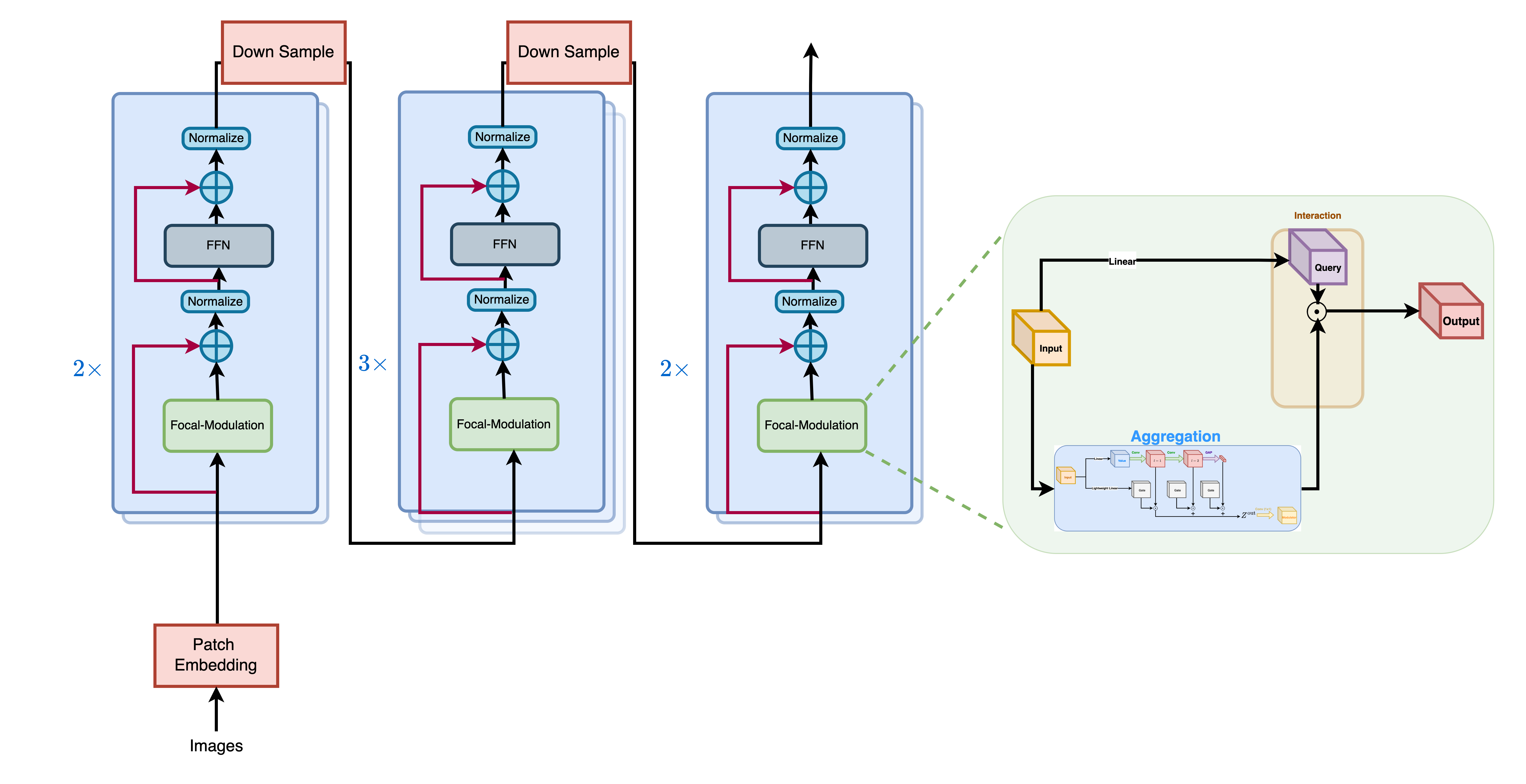
| Focul Modulation Networks are an alternative to Vision Transformers, where self-attention (SA) is completely replaced by a focal modulation mechanism for modeling token interactions in vision. |
| Focal modulation comprises three components: (i) hierarchical contextualization, implemented using a stack of depth-wise convolutional layers, to encode visual contexts from short to long ranges, (ii) gated aggregation to selectively gather contexts for each query token based on its |
| content, and (iii) element-wise modulation or affine transformation to inject the aggregated context into the query. Extensive experiments show FocalNets outperform the state-of-the-art SA counterparts (e.g., Vision Transformers, Swin and Focal Transformers) with similar computational costs on the tasks of image classification, object detection, and segmentation. |
|
|
|  |
|
|
| ## Intended uses & limitations |
|
|
| You can use the raw model for image classification. See the [model hub](https://huggingface.co/models?search=focalnet) to look for |
| fine-tuned versions on a task that interests you. |
|
|
| ### How to use |
|
|
| Here is how to use this model to classify an image of the COCO 2017 dataset into one of the 1,000 ImageNet classes: |
|
|
| ```python |
| from transformers import FocalNetImageProcessor, FocalNetForImageClassification |
| import torch |
| from datasets import load_dataset |
| |
| dataset = load_dataset("huggingface/cats-image") |
| image = dataset["test"]["image"][0] |
| |
| preprocessor = FocalNetImageProcessor.from_pretrained("microsoft/focalnet-small") |
| model = FocalNetForImageClassification.from_pretrained("microsoft/focalnet-small") |
| |
| inputs = preprocessor(image, return_tensors="pt") |
| |
| with torch.no_grad(): |
| logits = model(**inputs).logits |
| |
| # model predicts one of the 1000 ImageNet classes |
| predicted_label = logits.argmax(-1).item() |
| print(model.config.id2label[predicted_label]), |
| ``` |
|
|
| For more code examples, we refer to the [documentation](https://huggingface.co/docs/transformers/master/en/model_doc/focalnet). |
|
|
| ### BibTeX entry and citation info |
|
|
| ```bibtex |
| @article{DBLP:journals/corr/abs-2203-11926, |
| author = {Jianwei Yang and |
| Chunyuan Li and |
| Jianfeng Gao}, |
| title = {Focal Modulation Networks}, |
| journal = {CoRR}, |
| volume = {abs/2203.11926}, |
| year = {2022}, |
| url = {https://doi.org/10.48550/arXiv.2203.11926}, |
| doi = {10.48550/arXiv.2203.11926}, |
| eprinttype = {arXiv}, |
| eprint = {2203.11926}, |
| timestamp = {Tue, 29 Mar 2022 18:07:24 +0200}, |
| biburl = {https://dblp.org/rec/journals/corr/abs-2203-11926.bib}, |
| bibsource = {dblp computer science bibliography, https://dblp.org} |
| } |
| ``` |