

| # Unsupervised Learning | |
| This page contains a collection of unsupervised learning methods to learn sentence embeddings. The methods have in common that they **do not require labeled training data**. Instead, they can learn semantically meaningful sentence embeddings just from the text itself. | |
| **Note:** Unsupervised learning approaches are still an activate research area and in many cases the models perform rather poorly compared to models that are using training pairs as provided in our [training data collection](https://huggingface.co/datasets/sentence-transformers/embedding-training-data). A better approach is **[Domain Adaptation](../domain_adaptation/README.md)** where you combine unsupervised learning on your target domain with existent labeled data. This gives the best performance on your specific corpus. | |
| ## TSDAE | |
| In our work [TSDAE (Transformer-based Denoising AutoEncoder)](https://arxiv.org/abs/2104.06979) we present an unsupervised sentence embedding learning method based on denoising auto-encoders: | |
| 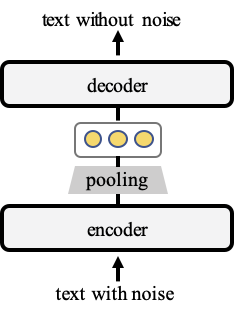 | |
| We add noise to the input text, in our case, we delete about 60% of the words in the text. The encoder maps this input to a fixed-sized sentence embeddings. A decoder then tries to re-create the original text without the noise. Later, we use the encoder as the sentence embedding methods. | |
| See **[TSDAE](TSDAE/README.md)** for more information and training examples. | |
| ## SimCSE | |
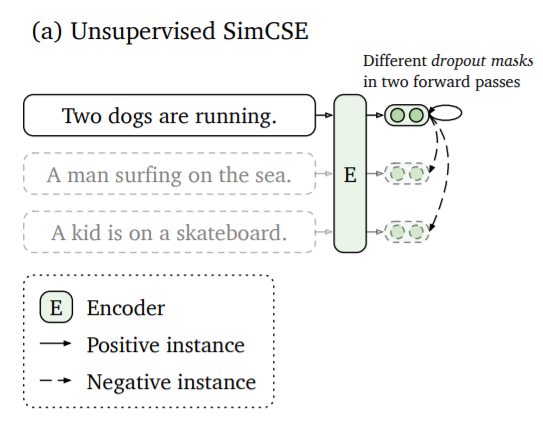
| Gao et al. present in [SimCSE: Simple Contrastive Learning of Sentence Embeddings](https://arxiv.org/abs/2104.08821) a method that passes the same sentence twice to the sentence embedding encoder. Due to the drop-out, it will be encoded at slightly different positions in vector space. | |
| The distance between these two embeddings will be minimized, while the distance to other embeddings of the other sentences in the same batch will be maximized. | |
|  | |
| See **[SimCSE](SimCSE/README.md)** for more information and training examples. | |
| ## CT | |
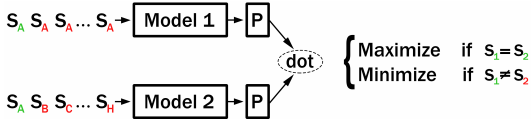
| Carlsson et al. present in [Semantic Re-Tuning With Contrastive Tension (CT)](https://openreview.net/pdf?id=Ov_sMNau-PF) an unsupervised method that uses two models: If the same sentences are passed to Model1 and Model2, then the respective sentence embeddings should get a large dot-score. If the different sentences are passed, then the sentence embeddings should get a low score. | |
|  | |
| See **[CT](CT/README.md)** for more information and training examples. | |
| ## CT (In-Batch Negative Sampling) | |
| The CT method from Carlsson et al. provides sentence pairs to the two models. This can be improved by using in-batch negative sampling: Model1 and Model2 both encode the same set of sentences. We maximize the scores for matching indexes (i.e. Model1(S_i) and Model2(S_i)) while we minimize the scores for different indexes (i.e. Model1(S_i) and Model2(S_j) for i != j). | |
| See **[CT_In-Batch_Negatives](CT_In-Batch_Negatives/README.md)** for more information and training examples. | |
| ## Masked Language Model (MLM) | |
| BERT showed that Masked Language Model (MLM) is a powerful pre-training approach. It is advisable to first run MLM a large dataset from your domain before you do fine-tuning. See **[MLM](MLM/README.md)** for more information and training examples. | |
| ## GenQ | |
| In our paper [BEIR: A Heterogenous Benchmark for Zero-shot Evaluation of Information Retrieval Models](https://arxiv.org/abs/2104.08663) we present a method to learn a semantic search method by generating queries for given passages. This method has been improved in [GPL: Generative Pseudo Labeling for Unsupervised Domain Adaptation of Dense Retrieval](https://arxiv.org/abs/2112.07577). | |
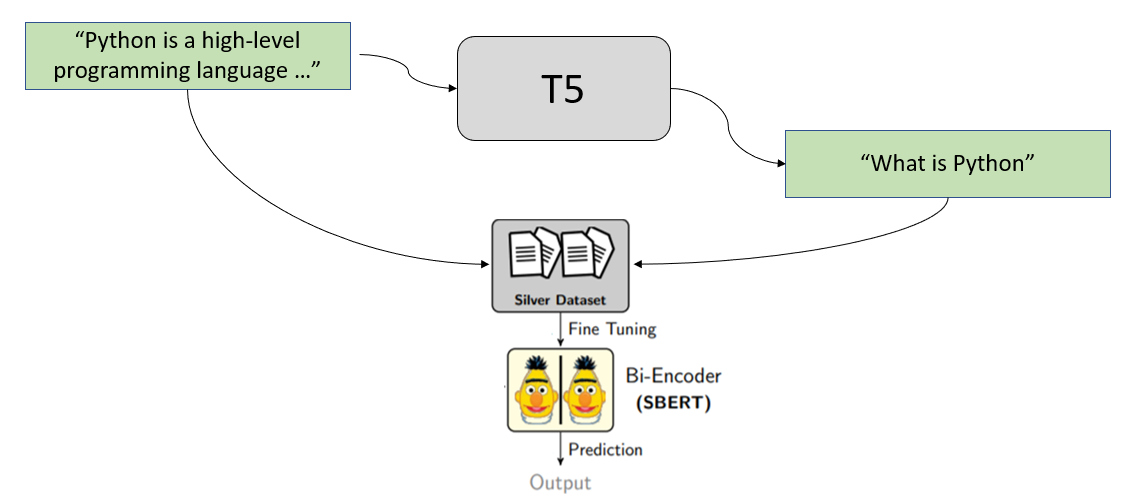
| We pass all passages in our collection through a trained T5 model, which generates potential queries from users. We then use these (query, passage) pairs to train a SentenceTransformer model. | |
|  | |
| See **[GenQ](query_generation/README.md)** for more information and training examples. See **[GPL](../domain_adaptation/README.md)** for the improved version that uses a multi-step training approach. | |
| ## GPL | |
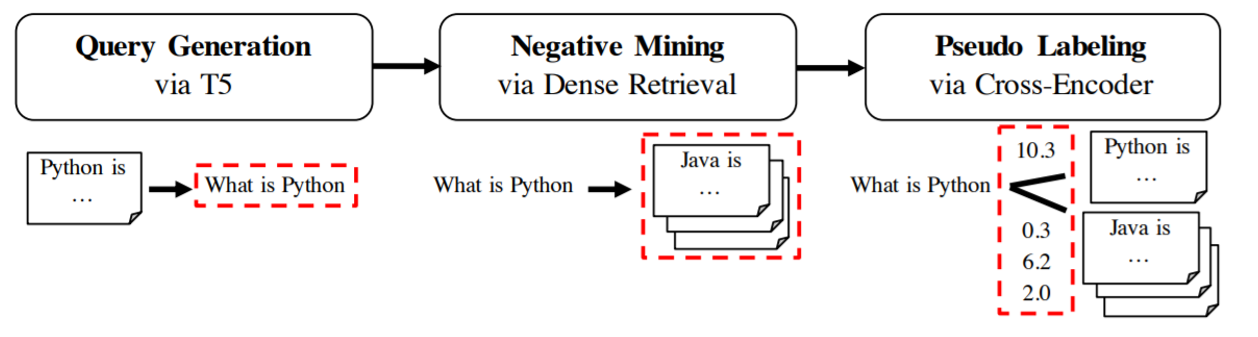
| In [GPL: Generative Pseudo Labeling for Unsupervised Domain Adaptation of Dense Retrieval](https://arxiv.org/abs/2112.07577) we show an improved version of GenQ, which combines the generation with negative mining and pseudo labeling using a Cross-Encoder. It leads to significantly improved results. See **[Domain Adaptation](../domain_adaptation/README.md)** for more information. | |
|  | |
| ## Performance Comparison | |
| In our paper | |
| [TSDAE](https://arxiv.org/abs/2104.06979) we compare approaches for sentence embedding tasks, and in [GPL](https://arxiv.org/abs/2112.07577) we compare them for semantic search tasks (given a query, find relevant passages). While the unsupervised approach achieve acceptable performances for sentence embedding tasks, they perform poorly for semantic search tasks. | |