

| # Cross-Encoders | |
| SentenceTransformers also supports to load Cross-Encoders for sentence pair scoring and sentence pair classification tasks. | |
| ## Bi-Encoder vs. Cross-Encoder | |
| First, it is important to understand the difference between Bi- and Cross-Encoder. | |
| **Bi-Encoders** produce for a given sentence a sentence embedding. We pass to a BERT independently the sentences A and B, which result in the sentence embeddings u and v. These sentence embedding can then be compared using cosine similarity: | |
| 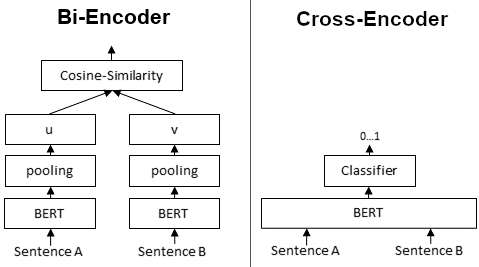 | |
| In contrast, for a **Cross-Encoder**, we pass both sentences simultaneously to the Transformer network. It produces then an output value between 0 and 1 indicating the similarity of the input sentence pair: | |
| A **Cross-Encoder does not produce a sentence embedding**. Also, we are not able to pass individual sentences to a Cross-Encoder. | |
| As detailed in our [paper](https://arxiv.org/abs/1908.10084), Cross-Encoder achieve better performances than Bi-Encoders. However, for many application they are not pratical as they do not produce embeddings we could e.g. index or efficiently compare using cosine similarity. | |
| ## When to use Cross- / Bi-Encoders? | |
| Cross-Encoders can be used whenever you have a pre-defined set of sentence pairs you want to score. For example, you have 100 sentence pairs and you want to get similarity scores for these 100 pairs. | |
| Bi-Encoders (see [Computing Sentence Embeddings](../computing-embeddings/README.md)) are used whenever you need a sentence embedding in a vector space for efficient comparison. Applications are for example Information Retrieval / Semantic Search or Clustering. Cross-Encoders would be the wrong choice for these application: Clustering 10,000 sentence with CrossEncoders would require computing similarity scores for about 50 Million sentence combinations, which takes about 65 hours. With a Bi-Encoder, you compute the embedding for each sentence, which takes only 5 seconds. You can then perform the clustering. | |
| ## Cross-Encoders Usage | |
| Using Cross-Encoders is quite easy: | |
| ```python | |
| from sentence_transformers.cross_encoder import CrossEncoder | |
| model = CrossEncoder('model_name_or_path') | |
| scores = model.predict([["My first", "sentence pair"], | |
| ["Second text", "pair"]]) | |
| ``` | |
| You pass to `model.predict` a list of sentence **pairs**. Note, Cross-Encoder do not work on individual sentence, you have to pass sentence pairs. | |
| As model name, you can pass any model or path that is compatible with Huggingface [AutoModel](https://huggingface.co/transformers/model_doc/auto.html) class | |
| For a full example, to score a query with all possible sentences in a corpus see [cross-encoder_usage.py](cross-encoder_usage.py). | |
| ## Combining Bi- and Cross-Encoders | |
| Cross-Encoder achieve higher performance than Bi-Encoders, however, they do not scale well for large datasets. Here, it can make sense to combine Cross- and Bi-Encoders, for example in Information Retrieval / Semantic Search scenarios: First, you use an efficient Bi-Encoder to retrieve e.g. the top-100 most similar sentences for a query. Then, you use a Cross-Encoder to re-rank these 100 hits by computing the score for every (query, hit) combination. | |
| For more details on combing Bi- and Cross-Encoders, see [Application - Information Retrieval](../retrieve_rerank/README.md). | |
| ## Training Cross-Encoders | |
| See [Cross-Encoder Training](../../training/cross-encoder/README.md) how to train your own Cross-Encoder models. | |