

Browser Mania
Collection
Models that can create wonders on the edge • 9 items • Updated
ONNX export of LiquidAI/LFM2.5-Encoder-350M-Prompt-Router, quantized to run fully in the browser through
transformers.js. No inference server: the weights are
fetched once, cached, and every forward pass happens in the tab.
A zero-shot prompt router. Categories are ordinary prose supplied at call time — nothing is trained or cached per label set. One bidirectional pass over the category list and the text scores every category at once.
All credit for the model itself goes to Liquid AI. This repository contains only a re-export; the weights are unchanged apart from quantization, and the original LFM Open License v1.0 applies.
Try it in your browser → — no install, no API key.
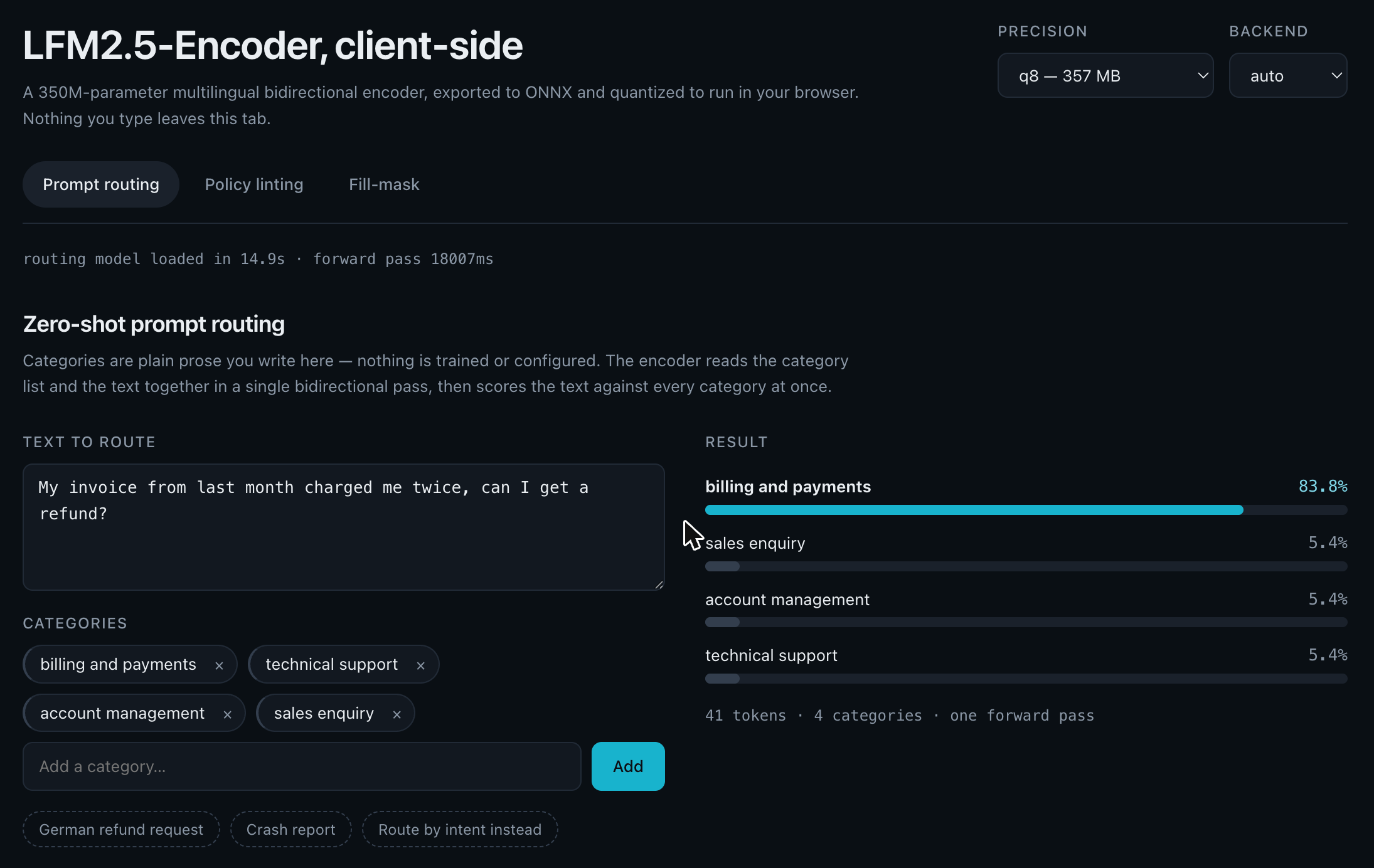
Tooling, demo and the export pipeline: https://github.com/kucukkanat/lfm-encoders
| dtype | File | Size |
|---|---|---|
q8 |
onnx/model_quantized.onnx |
357 MB |
q4 |
onnx/model_q4.onnx |
449 MB |
The graph takes input_ids + attention_mask, is dynamic in batch and sequence, and returns
token_proj and rule_proj.
import { AutoTokenizer, PreTrainedModel, Tensor } from "@huggingface/transformers";

const id = "kucukkanat/LFM2.5-Encoder-350M-Prompt-Router-ONNX";
const tokenizer = await AutoTokenizer.from_pretrained(id);
const model = await PreTrainedModel.from_pretrained(id, { dtype: "q8" });

const { input_ids } = tokenizer("some text");
const out = await model({
  input_ids,
  attention_mask: new Tensor("int64", new BigInt64Array(input_ids.dims[1]).fill(1n), input_ids.dims),
});
PreTrainedModel rather than AutoModel is deliberate: this is a plain "feed the named inputs, read the
named outputs" session, not one of transformers.js's built-in architectures.
Both projection towers expect one string laid out exactly like this — the model was trained on it and the character arithmetic that locates each label depends on it byte for byte:
Categories:
- label one
- label two

Text:
<the text>
token_proj is the query tower and rule_proj the key tower, both 256-d and emitted per token. Pool
the tokens covering each label to get its vector. Pooling after projecting is exact rather than an
approximation: both towers are affine, and an affine map commutes with a mean — which is what keeps one
static graph usable for any number of labels.
Scoring is cosine between the L2-normalised pooled towers, scaled by a learned temperature, then a softmax across labels.
@lfm-encoder/tasks implements all of this, including the
character-offset reconstruction transformers.js does not provide.
Measured from JavaScript against the fp32 PyTorch reference. Δ is the largest absolute difference in a final probability.
| dtype | max Δ | mean Δ | top-1 flips (4 cases) |
|---|---|---|---|
fp32 |
6.4e-5 | 1.6e-5 | 0 |
q8 |
0.0910 | 0.0230 | 0 |
q4 |
0.1221 | 0.0309 | 0 |
q8 is smaller on disk but uses more browser RAM than fp32 and runs slower: onnxruntime's WASM
kernels compute in float, so quantized weights are unpacked at session load. Quantization here buys
download size, not speed or memory.fp16 / q4f16 are deliberately absent: RMSNorm's variance overflows fp16 on this architecture and
every hidden state collapses to zeros.Base model
LiquidAI/LFM2.5-350M-Base