| --- |
| license: cc-by-4.0 |
| task_categories: |
| - image-classification |
| - image-feature-extraction |
| - video-classification |
| - image-segmentation |
| language: |
| - en |
| tags: |
| - liveness detection |
| - anti-spoofing |
| - biometrics |
| - facial recognition |
| - machine learning |
| - deep learning |
| - AI |
| - paper mask attack |
| - iBeta certification |
| - PAD attack |
| - security |
| - ibeta |
| - face recognition |
| - pad |
| - authentication |
| - fraud |
| size_categories: |
| - 1K<n<10K |
| pretty_name: Print Attack Dataset |
| --- |
| |
| # Liveness Detection Dataset: Photo Print attack dataset (3K individuals+) |
|
|
| ## What Is a Print Attack? |
|
|
| A print attack is a 2D presentation attack vector against face recognition and liveness detection systems, where an attacker presents a printed photo of a real person's face to a camera to deceive biometric authentication. Print attacks are the most common and accessible spoofing technique in face anti-spoofing research and represent the entry-level attack class tested in iBeta Level 1 PAD certification under the ISO/IEC 30107-3 standard |
|
|
| Robust face anti-spoofing systems must detect print attacks reliably under varied conditions - different lighting, distances, capture devices, and printing qualities. NIST FATE benchmarks also include print attack scenarios with zoom-in effects to evaluate algorithm performance under camera-distance variation, which is why this dataset includes 15–20 second videos with zoom-in phases |
|
|
| ## Full version of dataset is availible for commercial usage - leave a request on our website [Axon Labs](https://axonlab.ai/?utm_source=hugging-face&utm_medium=cpc&utm_campaign=profile&utm_content=profile_link) to purchase the dataset 💰 |
|
|
| ## Dataset Description: |
|
|
| - 3,000+ Participants: Engaged in the project |
| - Diverse Representation: Balanced mix of genders and ethnicities |
| - 7,000+ Photo Print Attacks: Executed on the participants |
|
|
| ## Photo Print attack description: |
|
|
| - Each attack comprises of 15-20 sec. video with Zoom in effects |
| - High-quality photos with realistic colors |
| - No visible image borders during the Zoom-in phase |
| - Paper attacks conducted on flat photos with a straight view on the camera (not bent or skewed) |
|
|
| ## Academic Baseline Reference |
|
|
| The canonical academic benchmark for print attack anti-spoofing research is the **Idiap Print-Attack Database** ([idiap.ch/en/scientific-research/data/printattack](https://www.idiap.ch/en/scientific-research/data/printattack)), published by the Idiap Research Institute as one of the foundational datasets in face anti-spoofing literature. This commercial dataset extends Idiap's research line with significantly more participants (3,000+ vs Idiap's 50), broader demographic representation, NIST-FATE-compliant zoom-in effects, and modern smartphone capture conditions, designed for production face recognition and liveness detection systems rather than research benchmarks alone |
|
|
| ## Potential Use Cases: |
| Liveness detection: This dataset is ideal for training and evaluating liveness detection models, enabling researchers to distinguish between selfies and photo print attacks with high accuracy |
|
|
|  |
|
|
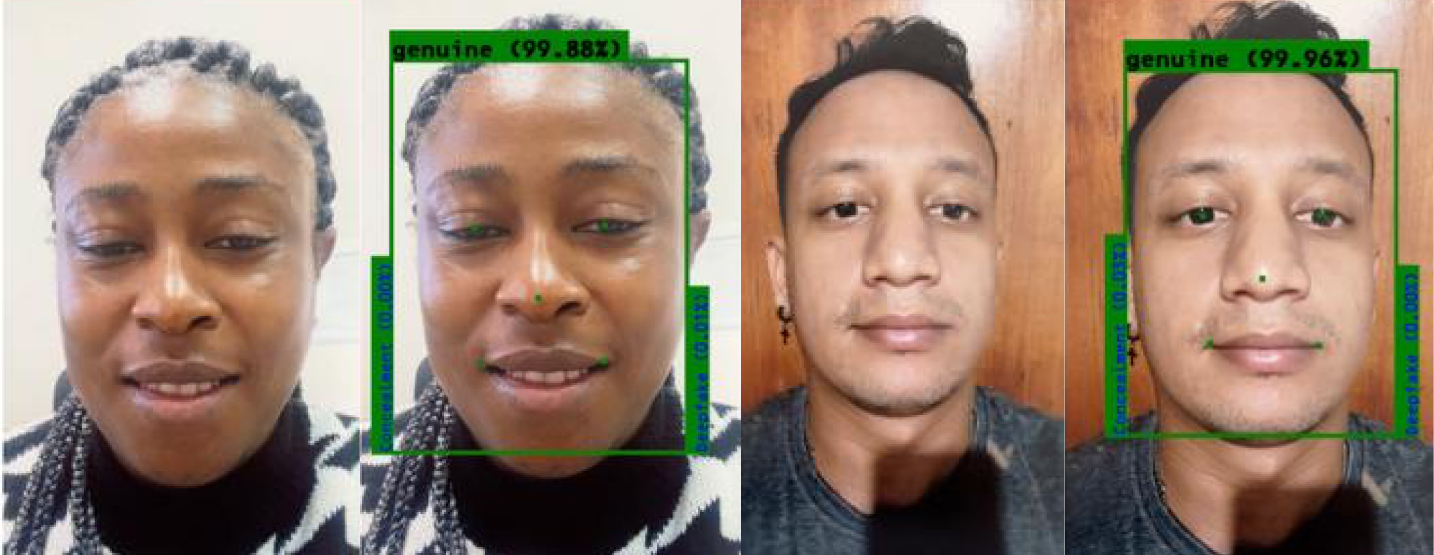
| Successfull Spoofing attack on a Liveness test by [Duobango ](https://www.doubango.org/webapps/face-liveness/) |
|
|
| Keywords: |
| Print photo attack dataset, Antispoofing for AI, Liveness Detection dataset for AI, Spoof Detection dataset, Facial Recognition dataset, Biometric Authentication dataset, AI Dataset, PAD Attack Dataset, Anti-Spoofing Technology, Facial Biometrics, Machine Learning Dataset, Deep Learning |