

File size: 5,044 Bytes
010c443 18ff1be 010c443 18ff1be 010c443 18ff1be 010c443 18ff1be 010c443 18ff1be 010c443 18ff1be 010c443 18ff1be 010c443 | 1 2 3 4 5 6 7 8 9 10 11 12 13 14 15 16 17 18 19 20 21 22 23 24 25 26 27 28 29 30 31 32 33 34 35 36 37 38 39 40 41 42 43 44 45 46 47 48 49 50 51 52 53 54 55 56 57 58 59 60 61 62 63 64 65 66 67 68 69 70 71 72 73 74 75 76 77 78 79 80 81 82 83 84 85 86 87 88 89 90 91 92 93 94 95 96 97 98 99 100 101 102 103 104 105 106 107 108 109 110 111 112 113 114 115 116 | ---
license: bsd-3-clause
library_name: braindecode
pipeline_tag: feature-extraction
tags:
- eeg
- biosignal
- pytorch
- neuroscience
- braindecode
- convolutional
- sleep-staging
---
# DeepSleepNet
DeepSleepNet from Supratak et al (2017) [Supratak2017].
> **Architecture-only repository.** Documents the
> `braindecode.models.DeepSleepNet` class. **No pretrained weights are
> distributed here.** Instantiate the model and train it on your own
> data.
## Quick start
```bash
pip install braindecode
```
```python
from braindecode.models import DeepSleepNet
model = DeepSleepNet(
n_chans=2,
sfreq=100,
input_window_seconds=30.0,
n_outputs=5,
)
```
The signal-shape arguments above are illustrative defaults — adjust to
match your recording.
## Documentation
- Full API reference: <https://braindecode.org/stable/generated/braindecode.models.DeepSleepNet.html>
- Interactive browser (live instantiation, parameter counts):
<https://huggingface.co/spaces/braindecode/model-explorer>
- Source on GitHub: <https://github.com/braindecode/braindecode/blob/master/braindecode/models/deepsleepnet.py#L12>
## Architecture
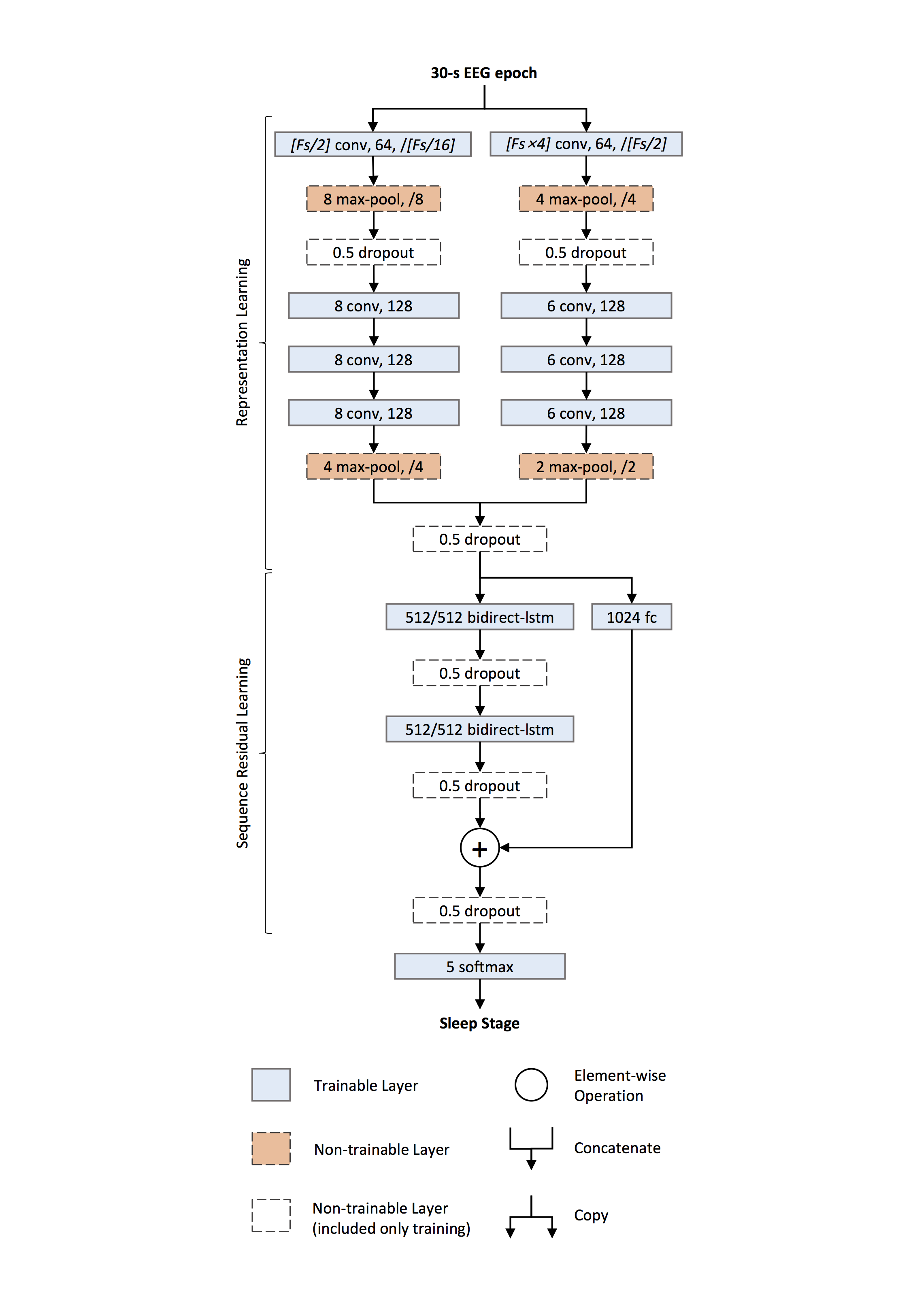
## Parameters
| Parameter | Type | Description |
|---|---|---|
| `activation_large` | type[nn.Module], default=nn.ELU | Activation class for the large-filter CNN path. |
| `activation_small` | type[nn.Module], default=nn.ReLU | Activation class for the small-filter CNN path. |
| `return_feats` | bool, default=False | If True, return features before the final linear layer. |
| `drop_prob` | float, default=0.5 | Dropout probability applied throughout the network. |
| `bilstm_hidden_size` | int, default=512 | Hidden size of the BiLSTM. The residual FC output dimension is `2 * bilstm_hidden_size` to match the concatenated directions. |
| `bilstm_num_layers` | int, default=2 | Number of stacked BiLSTM layers. |
| `small_n_filters_1` | int, default=64 | First-conv output channels for the small-filter path. |
| `small_n_filters_2` | int, default=128 | Deep-conv (conv2--conv4) output channels for the small-filter path. |
| `small_first_kernel_size` | int, default=50 | First-conv kernel size for the small path (paper: Fs/2). |
| `small_first_stride` | int, default=6 | First-conv stride for the small path (paper: Fs/16). |
| `small_first_padding` | int, default=22 | First-conv padding for the small path. |
| `small_pool1_kernel_size` | int, default=8 | First max-pool kernel for the small path. |
| `small_pool1_stride` | int, default=8 | First max-pool stride for the small path. |
| `small_pool1_padding` | int, default=2 | First max-pool padding for the small path. |
| `small_deep_kernel_size` | int, default=8 | Deep-conv kernel size for the small path. |
| `small_pool2_kernel_size` | int, default=4 | Second max-pool kernel for the small path. |
| `small_pool2_stride` | int, default=4 | Second max-pool stride for the small path. |
| `small_pool2_padding` | int, default=1 | Second max-pool padding for the small path. |
| `large_n_filters_1` | int, default=64 | First-conv output channels for the large-filter path. |
| `large_n_filters_2` | int, default=128 | Deep-conv (conv2--conv4) output channels for the large-filter path. |
| `large_first_kernel_size` | int, default=400 | First-conv kernel size for the large path (paper: 4*Fs). |
| `large_first_stride` | int, default=50 | First-conv stride for the large path (paper: Fs/2). |
| `large_first_padding` | int, default=175 | First-conv padding for the large path. |
| `large_pool1_kernel_size` | int, default=4 | First max-pool kernel for the large path. |
| `large_pool1_stride` | int, default=4 | First max-pool stride for the large path. |
| `large_pool1_padding` | int, default=0 | First max-pool padding for the large path. |
| `large_deep_kernel_size` | int, default=6 | Deep-conv kernel size for the large path. |
| `large_pool2_kernel_size` | int, default=2 | Second max-pool kernel for the large path. |
| `large_pool2_stride` | int, default=2 | Second max-pool stride for the large path. |
| `large_pool2_padding` | int, default=1 | Second max-pool padding for the large path. |
## References
1. Supratak, A., Dong, H., Wu, C., & Guo, Y. (2017). DeepSleepNet: A model for automatic sleep stage scoring based on raw single-channel EEG. IEEE Transactions on Neural Systems and Rehabilitation Engineering, 25(11), 1998-2008.
## Citation
Cite the original architecture paper (see *References* above) and braindecode:
```bibtex
@article{aristimunha2025braindecode,
title = {Braindecode: a deep learning library for raw electrophysiological data},
author = {Aristimunha, Bruno and others},
journal = {Zenodo},
year = {2025},
doi = {10.5281/zenodo.17699192},
}
```
## License
BSD-3-Clause for the model code (matching braindecode).
Pretraining-derived weights, if you fine-tune from a checkpoint,
inherit the licence of that checkpoint and its training corpus.
|