

Stable-Layers: Fine-Tuning Image Layer Decomposition Models with VLM-Scored Reinforcement Learning
Paper • 2605.30257 • Published • 8
Decomposing Images into Editable RGBA Layers
Paper Project Page Model (Hugging Face) Code
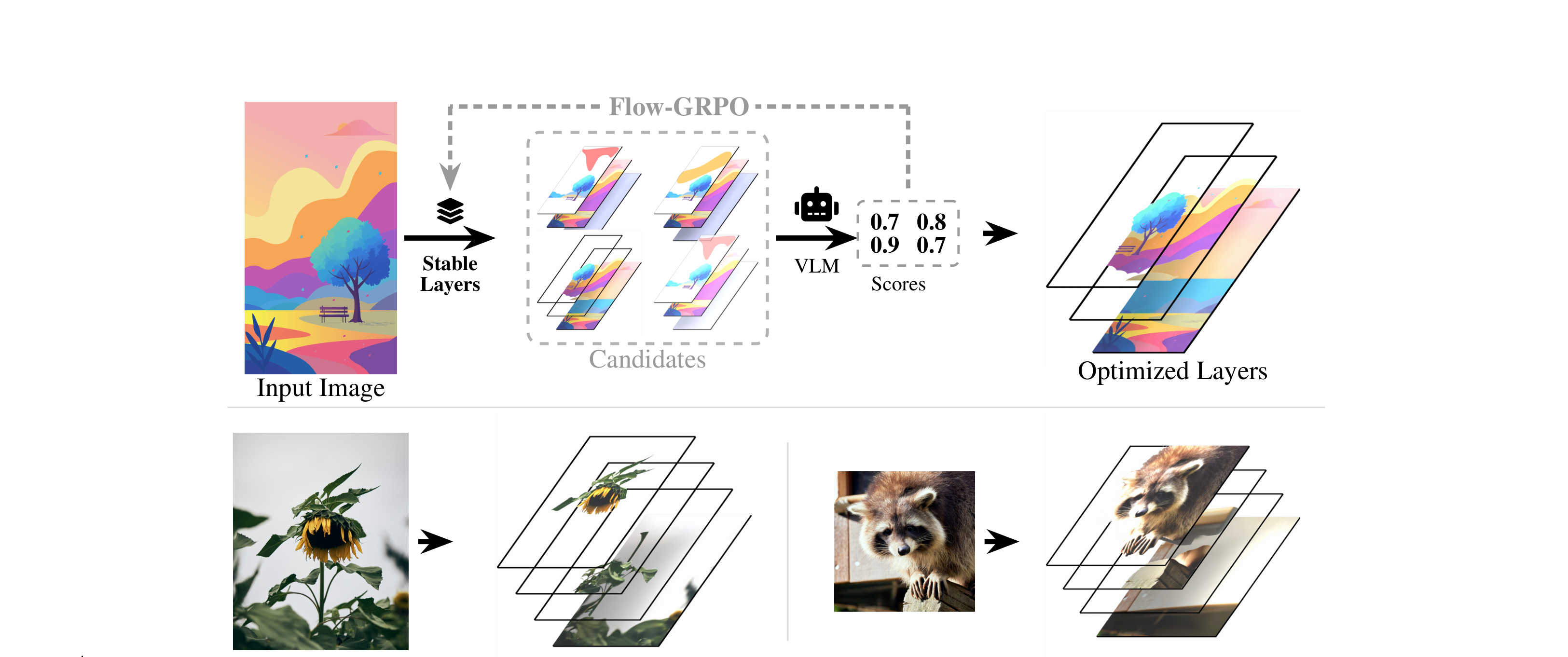
Stable Layers decomposes a single RGB image into a small stack of back-to-front RGBA layers (background plus object layers) suitable for compositing and editing.
This repository hosts the LoRA adapter over Qwen/Qwen-Image-Layered. This model
was trained using Qwen 3.5 9b as the VLM teacher.
This repository is the LoRA adapter (adapter_config.json,
adapter_model.safetensors). The base model is pulled from Hugging Face
automatically (Qwen/Qwen-Image-Layered). See the
code repository for the inference
script.
pip install torch diffusers transformers peft pillow numpy
Tested with torch 2.11, diffusers 0.37, transformers 5.5, peft 0.18.
Requires one GPU — the base model is ~40 GB in bf16, so an 80 GB-class card
(A100-80 / H100 / H200) is comfortable.
Heun sampler · 50 steps · CFG 1.0 · 640 px · 4 layers
| Setting | Value | Flag |
|---|---|---|
| Sampler | Heun (2nd order) | always used — not configurable |
| Steps | 50 | --steps 50 |
| CFG / guidance | 1.0 (off) | --guidance-scale 1.0 |
| Resolution | 640 px (max dim) | --size 640 |
| Layers | 4 | --num-layers 4 |
Note: using a higher resolution, lower steps, or a non-Heun sampler will garble the results.
# single image
python decompose.py --input photo.png --output results/

# a directory of images
python decompose.py --input images/ --output results/

# RGBA layers with real alpha (for compositing / editors)
python decompose.py --input images/ --output results/ --transparent

# explicit LoRA location
python decompose.py --input photo.png --output results/ --lora ./model
results/<image_name>/
  source.png       # input, resized
  composite.png    # layers recomposited — compare against source as a sanity check
  layer_0.png      # background (inpainted behind the removed objects)
  layer_1.png      # object layers, back-to-front
  layer_2.png
  layer_3.png
Layers are ordered back-to-front: layer_0 is the background, higher indices sit
on top. Not every image needs all 4 — unused layers come out blank, which is
normal.
By default layers are composited onto white (easy to eyeball). Pass
--transparent to get RGBA with real alpha, which is what you want when
importing into an editor or compositing them yourself.
Notes:
seed + image_index
(--seed 42 by default), so the same inputs give the same outputs."a clean, well composed image") is fine —
override with --prompt if you want.--size and both
dimensions are rounded to multiples of 16.This code and model usage are subject to Stability AI Community License terms.
For individuals or organizations generating annual revenue of USD 1,000,000 (or local currency equivalent) or more, commercial usage requires an enterprise license from Stability AI.
@article{stablelayers2026,
  author  = {},
  title   = {Stable Layers: Decomposing Images into Editable RGBA Layers},
  journal = {arXiv preprint arXiv:2605.30257},
  year    = {2026}
}