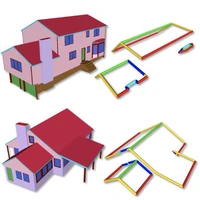
| | import trimesh |
| | import numpy as np |
| | from copy import deepcopy |
| | from PIL import Image |
| |
|
| | from . import color_mappings |
| |
|
| | def line(p1, p2, c=(255,0,0), resolution=10, radius=0.05): |
| | '''draws a 3d cylinder along the line (p1, p2)''' |
| | |
| | if len(c) == 1: |
| | c = [c[0]]*4 |
| | elif len(c) == 3: |
| | c = [*c, 255] |
| | elif len(c) != 4: |
| | raise ValueError(f'{c} is not a valid color (must have 1,3, or 4 elements).') |
| | |
| | |
| | p1, p2 = np.asarray(p1), np.asarray(p2) |
| | l = np.linalg.norm(p2-p1) |
| | |
| | direction = (p2 - p1) / l |
| | |
| | |
| | T = np.eye(4) |
| | T[:3, 2] = direction |
| | T[:3, 3] = (p1+p2)/2 |
| | |
| | |
| | b0, b1 = T[:3, 0], T[:3, 1] |
| | if np.abs(np.dot(b0, direction)) < np.abs(np.dot(b1, direction)): |
| | T[:3, 1] = -np.cross(b0, direction) |
| | else: |
| | T[:3, 0] = np.cross(b1, direction) |
| | |
| | |
| | mesh = trimesh.primitives.Cylinder(radius=radius, height=l, transform=T) |
| | |
| | |
| | mesh.visual.vertex_colors = np.ones_like(mesh.visual.vertex_colors)*c |
| | |
| | return mesh |
| |
|
| | def show_wf(row, radius=10, show_vertices=False, vertex_color=(255,0,0, 255)): |
| | EDGE_CLASSES = ['eave', |
| | 'ridge', |
| | 'step_flashing', |
| | 'rake', |
| | 'flashing', |
| | 'post', |
| | 'valley', |
| | 'hip', |
| | 'transition_line'] |
| | out_meshes = [] |
| | if show_vertices: |
| | out_meshes.extend([trimesh.primitives.Sphere(radius=radius+5, center = center, color=vertex_color) for center in row['wf_vertices']]) |
| | for m in out_meshes: |
| | m.visual.vertex_colors = np.ones_like(m.visual.vertex_colors)*vertex_color |
| | if 'edge_semantics' not in row: |
| | print ("Warning: edge semantics is not here, skipping") |
| | out_meshes.extend([line(a,b, radius=radius, c=(214, 251, 248)) for a,b in np.stack([*row['wf_vertices']])[np.stack(row['wf_edges'])]]) |
| | elif len(np.stack(row['wf_edges'])) == len(row['edge_semantics']): |
| | out_meshes.extend([line(a,b, radius=radius, c=color_mappings.gestalt_color_mapping[EDGE_CLASSES[cls_id]]) for (a,b), cls_id in zip(np.stack([*row['wf_vertices']])[np.stack(row['wf_edges'])], row['edge_semantics'])]) |
| | else: |
| | print ("Warning: edge semantics has different length compared to edges, skipping semantics") |
| | out_meshes.extend([line(a,b, radius=radius, c=(214, 251, 248)) for a,b in np.stack([*row['wf_vertices']])[np.stack(row['wf_edges'])]]) |
| | return out_meshes |
| | |
| |
|
| |
|
| | def show_grid(edges, meshes=None, row_length=5): |
| | ''' |
| | edges: list of list of meshes |
| | meshes: optional corresponding list of meshes |
| | row_length: number of meshes per row |
| | |
| | returns trimesh.Scene() |
| | ''' |
| | |
| | T = np.eye(4) |
| | out = [] |
| | edges = [sum(e[1:], e[0]) for e in edges] |
| | row_height = 1.1 * max((e.extents for e in edges), key=lambda e: e[1])[1] |
| | col_width = 1.1 * max((e.extents for e in edges), key=lambda e: e[0])[0] |
| | |
| | |
| | if meshes is None: |
| | meshes = [None]*len(edges) |
| |
|
| | for i, (gt, mesh) in enumerate(zip(edges, meshes), start=0): |
| | mesh = deepcopy(mesh) |
| | gt = deepcopy(gt) |
| |
|
| | if i%row_length != 0: |
| | T[0, 3] += col_width |
| |
|
| | else: |
| | T[0, 3] = 0 |
| | T[1, 3] += row_height |
| |
|
| | |
| | |
| | if mesh is not None: |
| | mesh.apply_transform(T) |
| | out.append(mesh) |
| | |
| | gt.apply_transform(T) |
| | out.append(gt) |
| | |
| | |
| | out.extend([mesh, gt]) |
| |
|
| | |
| | return trimesh.Scene(out) |
| |
|
| |
|
| |
|
| |
|
| | def visualize_order_images(row_order): |
| | return create_image_grid(row_order['ade20k'] + row_order['gestalt'] + [visualize_depth(dm) for dm in row_order['depthcm']], num_per_row=len(row_order['ade20k'])) |
| |
|
| | def create_image_grid(images, target_length=312, num_per_row=2): |
| | |
| | first_img = images[0] |
| | aspect_ratio = first_img.width / first_img.height |
| | new_width = int((target_length ** 2 * aspect_ratio) ** 0.5) |
| | new_height = int((target_length ** 2 / aspect_ratio) ** 0.5) |
| | |
| | |
| | resized_images = [img.resize((new_width, new_height), Image.Resampling.LANCZOS) for img in images] |
| | |
| | |
| | num_rows = (len(resized_images) + num_per_row - 1) // num_per_row |
| | grid_width = new_width * num_per_row |
| | grid_height = new_height * num_rows |
| | |
| | |
| | grid_img = Image.new('RGB', (grid_width, grid_height)) |
| | |
| | |
| | for i, img in enumerate(resized_images): |
| | x_offset = (i % num_per_row) * new_width |
| | y_offset = (i // num_per_row) * new_height |
| | grid_img.paste(img, (x_offset, y_offset)) |
| | |
| | return grid_img |
| |
|
| |
|
| | import matplotlib.pyplot as plt |
| |
|
| | def visualize_depth(depth, min_depth=None, max_depth=None, cmap='rainbow'): |
| | depth = np.array(depth) |
| | |
| | if min_depth is None: |
| | min_depth = np.min(depth) |
| | if max_depth is None: |
| | max_depth = np.max(depth) |
| | |
| | |
| | |
| | depth = (depth - min_depth) / (max_depth - min_depth) |
| | depth = np.clip(depth, 0, 1) |
| | |
| | |
| | cmap = plt.get_cmap(cmap) |
| | depth_image = (cmap(depth) * 255).astype(np.uint8) |
| | |
| | |
| | depth_image = Image.fromarray(depth_image) |
| | |
| | return depth_image |