

File size: 8,770 Bytes
992872c 8df73a7 992872c 6cabf3e 992872c b606971 84651ff b606971 84651ff |
1 2 3 4 5 6 7 8 9 10 11 12 13 14 15 16 17 18 19 20 21 22 23 24 25 26 27 28 29 30 31 32 33 34 35 36 37 38 39 40 41 42 43 44 45 46 47 48 49 50 51 52 53 54 55 56 57 58 59 60 61 62 63 64 65 66 67 68 69 70 71 72 73 74 75 76 77 78 79 80 81 82 83 84 85 86 87 88 89 90 91 92 93 94 95 96 97 98 99 100 101 102 103 104 105 106 107 108 109 110 111 112 113 114 115 116 117 118 119 120 121 122 123 124 125 126 127 128 129 130 131 132 133 134 135 136 137 138 139 140 141 142 143 144 145 146 147 148 149 150 151 152 153 154 155 156 157 158 159 160 161 162 163 164 165 166 167 168 169 170 171 172 173 174 175 176 177 178 179 180 181 182 183 184 185 186 187 188 189 190 191 192 193 194 195 196 197 198 199 200 201 202 203 204 205 206 207 208 209 210 211 212 213 214 215 216 217 218 219 220 221 222 223 224 225 226 227 228 229 230 231 232 233 234 235 236 237 238 239 240 241 242 243 244 245 246 247 248 249 250 251 252 253 254 255 256 257 258 259 260 261 262 263 264 265 266 267 268 269 270 271 272 273 274 275 276 277 278 279 280 281 282 283 284 285 286 287 288 289 290 291 292 293 294 295 296 297 298 299 300 301 302 303 304 305 306 307 308 309 310 311 312 313 314 315 316 317 318 319 320 321 322 323 324 325 326 327 328 329 330 331 332 333 334 335 336 337 338 339 340 341 342 343 344 345 346 347 348 349 350 351 352 353 354 355 356 357 358 359 360 361 362 363 364 365 366 367 368 369 370 |
---
title: Animal Image Classification Using InceptionV3
emoji: 🐍
colorFrom: blue
colorTo: red
sdk: gradio
sdk_version: 6.5.1
app_file: app.py
pinned: false
license: mit
short_description: InceptionV3-based animal image classifier with data cleaning
models:
- AIOmarRehan/Animal-Image-Classification-Using-CNN
datasets:
- AIOmarRehan/AnimalsDataset
---
[If you would like a detailed explanation of this project, please refer to the Medium article below.](https://medium.com/@ai.omar.rehan/building-a-clean-reliable-and-accurate-animal-classifier-using-inceptionv3-175f30fbe6f3)
---
# Animal Image Classification Using InceptionV3
*A complete end-to-end pipeline for building a clean, reliable deep-learning classifier.*
This project implements a **full deep-learning workflow** for classifying animal images using **TensorFlow + InceptionV3**, with a major focus on **dataset validation and cleaning**. Before training the model, I built a comprehensive system to detect corrupted images, duplicates, brightness/contrast issues, mislabeled samples, and resolution outliers.
This repository contains the full pipeline—from dataset extraction to evaluation and model saving.
---
## Features
### Full Dataset Validation
The project includes automated checks for:
* Corrupted or unreadable images
* Hash-based duplicate detection
* Duplicate filenames
* Misplaced or incorrectly labeled images
* File naming inconsistencies
* Extremely dark/bright images
* Very low-contrast (blank) images
* Outlier resolutions
### Preprocessing & Augmentation
* Resize to 256×256
* Normalization
* Light augmentation (probabilistic)
* Efficient `tf.data` pipeline with caching, shuffling, prefetching
### Transfer Learning with InceptionV3
* Pretrained ImageNet weights
* Frozen base model
* Custom classification head (GAP → Dense → Dropout → Softmax)
* EarlyStopping + ModelCheckpoint + ReduceLROnPlateau callbacks
### Clean & Reproducible Training
* 80% training
* 10% validation
* 10% test
* High stability due to dataset cleaning
---
## 1. Dataset Extraction
The dataset is stored as a ZIP file (Google Drive). After mounting the drive, it is extracted and indexed into a Pandas DataFrame:
```python
drive.mount('/content/drive')
zip_path = '/content/drive/MyDrive/Animals.zip'
extract_to = '/content/my_data'
with zipfile.ZipFile(zip_path, 'r') as zip_ref:
zip_ref.extractall(extract_to)
```
Each image entry records:
* Class
* Filename
* Full path
---
## 2. Dataset Exploration
Before any training, I analyzed:
* Class distribution
* Image dimensions
* Grayscale vs RGB
* Unique sizes
* Folder structures
Example class-count visualization:
```python
plt.figure(figsize=(32, 16))
class_count.plot(kind='bar')
```
This revealed imbalance and inconsistent image sizes early.
---
## 3. Visual Sanity Checks
Random images were displayed with their brightness, contrast, and shape to manually confirm dataset quality.
This step prevents hidden issues—especially in community-created or scraped datasets.
---
## 4. Data Quality Detection
The system checks for:
### Duplicate Images (Using MD5 Hashing)
```python
def get_hash(path):
with open(path, 'rb') as f:
return hashlib.md5(f.read()).hexdigest()
df['file_hash'] = df['full_path'].apply(get_hash)
duplicate_hashes = df[df.duplicated('file_hash', keep=False)]
```
### Corrupted Files
```python
try:
with Image.open(file_path) as img:
img.verify()
except:
corrupted_files.append(file_path)
```
### Brightness/Contrast Outliers
Using PIL’s `ImageStat` to detect very dark/bright samples.
### Label Consistency Check
```python
folder = os.path.basename(os.path.dirname(row["full_path"]))
```
This catches mislabeled entries where folder name ≠ actual class.
---
## 5. Preprocessing Pipeline
Custom preprocessing:
* Resize → Normalize
* Optional augmentation
* Efficient `tf.data` batching
```python
def preprocess_image(path, target_size=(256, 256), augment=True):
img = tf.image.decode_image(...)
img = tf.image.resize(img, target_size)
img = img / 255.0
```
Split structure:
| Split | Percent |
| ---------- | ------- |
| Train | 80% |
| Validation | 10% |
| Test | 10% |
---
## 6. Model — Transfer Learning with InceptionV3
The model is built using **InceptionV3 pretrained on ImageNet** as a feature extractor.
```python
inception = InceptionV3(
input_shape=input_shape,
weights="imagenet",
include_top=False
)
```
At first, **all backbone layers are frozen** to preserve pretrained representations:
```python
for layer in inception.layers:
layer.trainable = False
```
A custom classification head is added:
* GlobalAveragePooling2D
* Dense(512, ReLU)
* Dropout(0.5)
* Dense(N, Softmax) — where *N = number of classes*
This setup allows the model to learn dataset-specific patterns while avoiding overfitting during early training.
---
## 7. Initial Training (Frozen Backbone "Feature Extraction")
The model is compiled using:
* **Loss**: `sparse_categorical_crossentropy`
* **Optimizer**: Adam
* **Metric**: Accuracy
Training is performed with callbacks to improve stability:
* **EarlyStopping** (restore best weights)
* **ModelCheckpoint** (save best model)
* **ReduceLROnPlateau**
```python
history = model.fit(
train_ds,
validation_data=val_ds,
epochs=5,
callbacks=callbacks
)
```
This stage allows the new classification head to converge while keeping the pretrained backbone intact.
---
## 8. Fine-Tuning the InceptionV3 Backbone
After the initial convergence, **fine-tuning is applied** to improve performance.
The **last 30 layers** of InceptionV3 are unfrozen:
The model is then recompiled and trained again:
```python
history = model.fit(
train_ds,
validation_data=val_ds,
epochs=10,
callbacks=callbacks
)
```
Fine-tuning allows higher-level convolutional filters to adapt to the animal dataset, resulting in better class separation and generalization.
---
## 9. Model Evaluation
The final model is evaluated on a **held-out test set**.
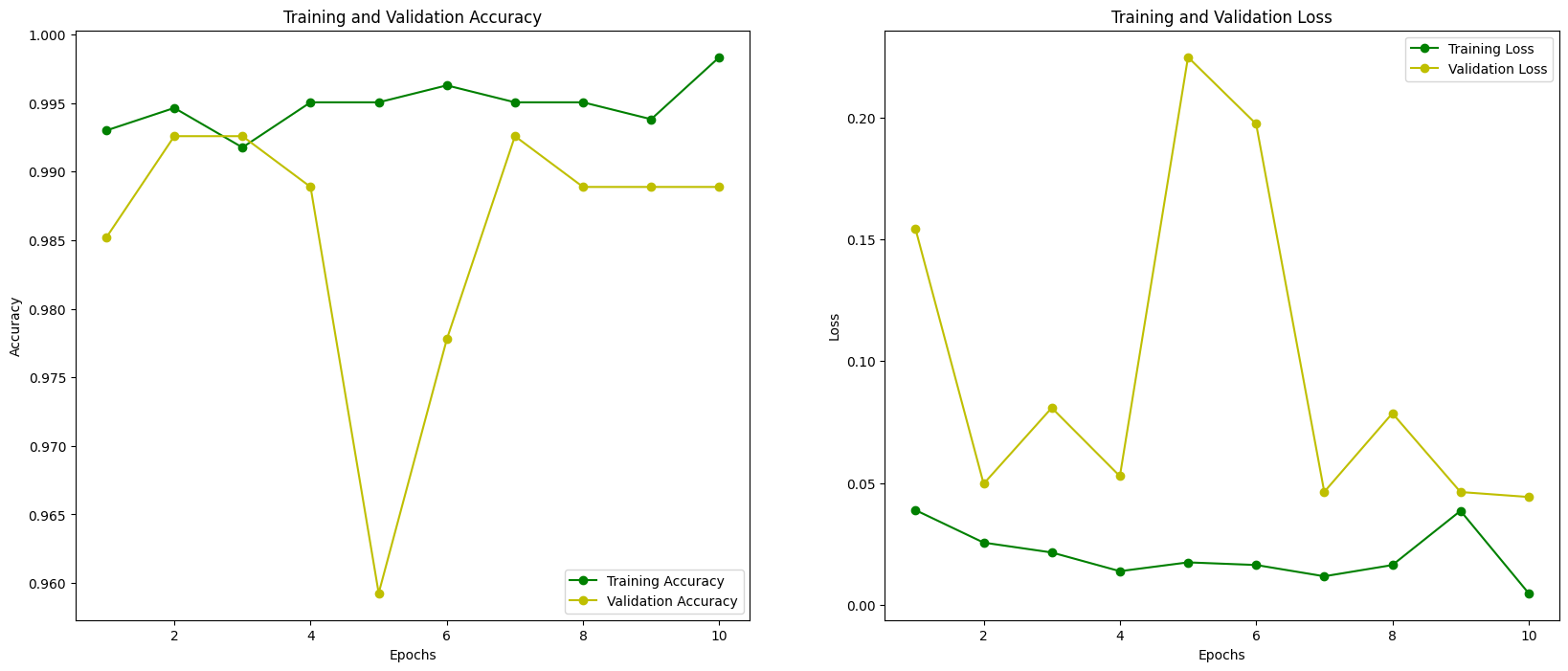
### Accuracy & Loss Curves
Training and validation curves are plotted to monitor:
* Convergence behavior
* Overfitting
* Generalization stability
These plots confirm that fine-tuning improves validation performance without introducing instability.
---
### Confusion Matrix
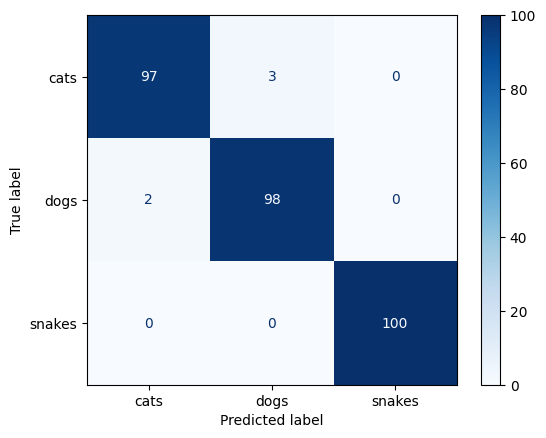
A confusion matrix is computed to visualize class-level performance:
* Highlights misclassification patterns
* Reveals class confusion (e.g., visually similar animals)
Both annotated and heatmap-style confusion matrices are generated.
---
### Classification Metrics
The following metrics are computed on the test set:
* **Accuracy**
* **Precision (macro)**
* **Recall (macro)**
* **F1-score (macro)**
A detailed **per-class classification report** is also produced:
* Precision
* Recall
* F1-score
* Support
This provides a deeper understanding beyond accuracy alone.
```
10/10 ━━━━━━━━━━━━━━━━━━━━ 1s 106ms/step - accuracy: 0.9826 - loss: 0.3082 - Test Accuracy: 0.9900
10/10 ━━━━━━━━━━━━━━━━━━━━ 1s 93ms/step
Classification Report:
precision recall f1-score support
cats 0.99 0.97 0.98 100
dogs 0.97 0.99 0.98 100
snakes 1.00 1.00 1.00 100
accuracy 0.99 300
macro avg 0.99 0.99 0.99 300
weighted avg 0.99 0.99 0.99 300
```
---
### ROC Curves (Multi-Class)
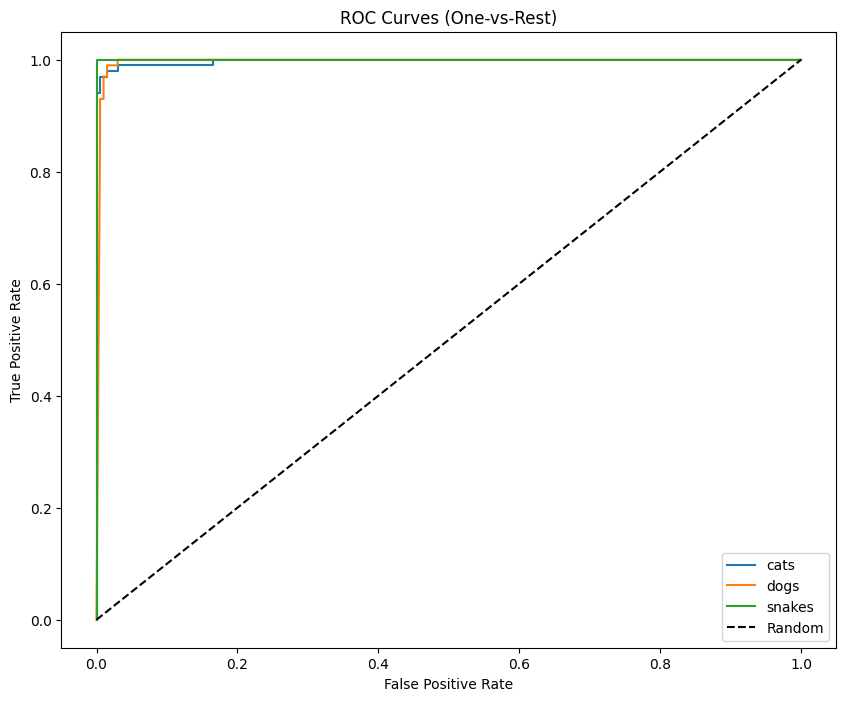
To further evaluate model discrimination:
* One-vs-Rest ROC curves are generated per class
* A **macro-average ROC curve** is computed
* AUC is reported for overall performance
These curves demonstrate strong separability across all classes.
---
## 10. Final Model
The best-performing model (after fine-tuning) is saved and later used for deployment:
```python
model.save("Inception_V3_Animals_Classification.h5")
```
This trained model is deployed using **FastAPI + Docker** for inference and **Gradio on Hugging Face Spaces** for public interaction.
---
## Updated Key Takeaways
> **Clean data enables strong fine-tuning.**
By combining:
* Rigorous dataset validation
* Transfer learning
* Selective fine-tuning
* Comprehensive evaluation
the model achieves **high accuracy, stable convergence, and reliable real-world performance**.
Fine-tuning only a subset of pretrained layers strikes the optimal balance between **generalization and specialization**.
--- |