
DART-SD: Diamond-topology Aware Retrieval and Tuning for Self-Distillation of Multi-Turn Tool-Calling Agents




Abstract
DART-SD improves multi-turn tool-calling agents by modeling execution as a diamond-topology graph, identifying critical failure points, and applying localized self-distillation to preserve valid reasoning while correcting errors.
Equipping Large Language Models (LLMs) with multi-turn tool-calling capabilities is essential for building autonomous agents. However, progress is fundamentally limited by the reliance on full-length trajectory imitation. For tasks involving multiple order-independent sub-goals, the optimal solution space forms a vast combinatorial diamond lattice. Forcing this rich topology into monolithic trajectories causes a severe topological collapse, indiscriminately penalizing valid alternative explorations and severely degrading policy diversity. To address this, we propose DART-SD (Diamond-topology Aware Retrieval and Tuning for Self-Distillation), a novel framework that shifts the paradigm from global forcing to topology-guided localized correction. DART-SD first models the execution process as a converging Interaction-State Transition Graph (ISTG), faithfully capturing the inherent diamond topology of successful and failed exploratory paths. During autonomous rollouts, the framework identifies the Critical Topological Breakpoint (CTB) and retrieves success-supported recovery references. Finally, we introduce a progressive self-distillation paradigm through CTB-guided localized supervision, ensuring that the training loss is calculated exclusively on the generated recovery steps while strictly protecting the valid reasoning prefix from destructive gradient updates. Experiments on complex multi-turn tool-calling benchmarks demonstrate that DART-SD significantly outperforms traditional full-trajectory baselines.
Community
🚀 We introduce DART-SD, a topology-aware self-distillation framework for multi-turn tool-calling agents.
Existing SFT and RL methods typically treat tool-use trajectories as linear sequences, which can incorrectly penalize valid alternative exploration. DART-SD instead models tool interactions as an Interaction-State Transition Graph (ISTG), capturing the inherent diamond topology induced by order-independent sub-goals.
Based on this structure, DART-SD identifies the Critical Topological Breakpoint (CTB) of failed trajectories, retrieves success-supported recovery paths, and applies localized supervision only after the breakpoint, preserving already-correct reasoning prefixes.
Across five tool-use benchmarks and two model scales, DART-SD consistently outperforms strong SFT and RL baselines. Notably, the Qwen3-8B student even surpasses its much larger teacher on several benchmarks.
💡 Rather than forcing agents to imitate entire trajectories, DART-SD learns where the reasoning actually goes wrong — and only fixes from there.

This is an automated message from the Librarian Bot. I found the following papers similar to this paper.
The following papers were recommended by the Semantic Scholar API
- TurnSight: Turn-Level Hindsight Self-Distillation for Tool-Integrated Reasoning (2026)
- DeepSearch-World: Self-Distillation for Deep Search Agents in a Verifiable Environment (2026)
- From Trajectories to Prefixes: Reusing Teacher Trajectories via Replayed Prefixes and Online Continuation (2026)
- Beyond Outcome Rewards: Step-Level Self-Distilled Policy Optimization for Deep Search Agents (2026)
- UI-MOPD: Multi-Platform On-Policy Distillation for Unified GUI Agents (2026)
- From Proprietary to Open-Source: Bridging the Distribution Gap via Multi-Agent Protocol Distillation in Agentic Search (2026)
- EviSD: Evidence-Conditioned Self-Distillation for Search-Augmented Agents (2026)
Please give a thumbs up to this comment if you found it helpful!
If you want recommendations for any Paper on Hugging Face checkout this Space
You can directly ask Librarian Bot for paper recommendations by tagging it in a comment: @librarian-bot recommend

This is an automated message from the ResearchStudio team.
We created an interactive ResearchStudio Reel for this paper. It includes a visual poster, a video, and a blog, all available for download in editable formats.
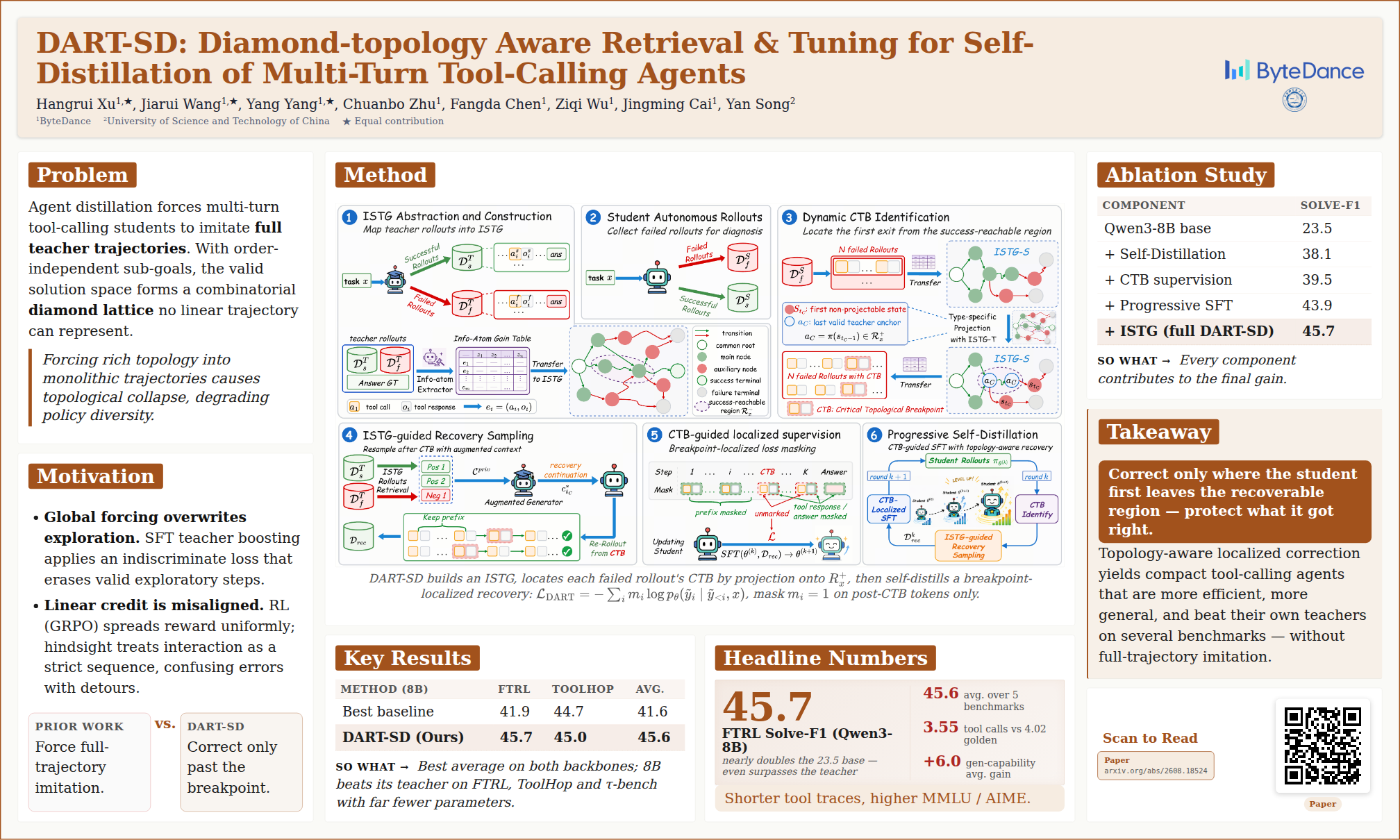
Open the ResearchStudio Reel →
Please give this comment a thumbs up if you find the Reel helpful!
Want to explore or create Reels for more papers? Visit the ResearchStudio demo.


Get this paper in your agent:
hf papers read 2608.18524 Don't have the latest CLI?
curl -LsSf https://hf.co/cli/install.sh | bash Models citing this paper 0
No model linking this paper
Datasets citing this paper 0
No dataset linking this paper
Spaces citing this paper 0
No Space linking this paper